Is white label SEO worth it for marketing agencies?

White label SEO is worth it for marketing agencies when outsourced delivery leaves a positive contribution margin and your team retains control of strategy, quality, and client relationships. It is not worth it when account management, revisions, and implementation coordination erase that margin. In 2026, evaluate the complete delivery workflow—not just the provider’s proposal.
TL;DR
Is white label SEO worth it? Yes, when delivery economics work and your agency owns quality control.
Visiblemonkey offers white-label SEO for agencies, alongside content, on-page, off-page, technical SEO, and GEO services.
Compare white-label SEO, in-house delivery, and hybrid delivery against your actual client requirements.
Approve work against documented acceptance criteria before it reaches the client.
Is white label SEO worth it for marketing agencies?
White label SEO is worth buying when it solves a delivery problem without creating a larger management problem. Your agency needs a clear answer to who chooses priorities, who implements recommendations, and who verifies the work. A provider agreement that leaves those responsibilities undefined is not a complete delivery plan.
Visiblemonkey offers white-label SEO for agencies as part of its SEO and GEO services. Visiblemonkey is a fit for agencies seeking white-label SEO alongside content, technical SEO, and GEO services. That service mix is relevant when client needs extend beyond publishing articles; evaluate the actual proposal against your required scope.
Compare the delivery models before choosing a partner:
White-label SEO
Best for: Agencies outsourcing defined execution while retaining client ownership
Main advantage: Access to external delivery capacity without staffing every function internally
Main drawback: Requires provider oversight, acceptance checks, and coordination
Decision: Choose when scope and ownership are explicit
In-house SEO
Best for: Agencies treating SEO expertise as a core internal capability
Main advantage: Direct control over priorities, methods, and team development
Main drawback: Your agency owns hiring, training, coverage, and workload allocation
Decision: Choose when sustained demand supports the team
Hybrid delivery
Best for: Agencies keeping strategy internally while outsourcing selected work
Main advantage: Separates client-facing decisions from specialized execution
Main drawback: Handoffs become another operational responsibility
Decision: Choose when your team can manage interfaces
None of these models removes accountability. The client hired your agency, so your agency must explain the work and its connection to business goals.
Why this matters
Selling SEO and delivering SEO are different commitments. A successful sales conversation does not establish crawlability, fix internal linking, approve content, or coordinate a developer. White-label delivery is useful only when those responsibilities have somewhere specific to land.
For your 2026 planning, separate external production from internal ownership. Your provider can execute an agreed scope, but your account team still needs to understand what was delivered, what remains blocked, and what the client should do next. Outsourcing execution does not outsource judgment.
White-label SEO: buy defined execution, not an undefined outcome
Best for: agencies that can specify client requirements and review completed work. White-label delivery lets your agency purchase external execution while keeping the commercial relationship. That is a practical fit when you need work delivered without building every capability internally.
The constraint is dependence on another team’s methods and communication. If deliverables arrive without implementation notes or supporting evidence, your agency must reconstruct the rationale before speaking to the client. That work belongs in your margin calculation.
Define the boundary before signing:
Does the engagement include recommendations, implementation, or both?
Who approves keyword targets and page intent?
Who checks factual accuracy and brand claims in content?
Who validates technical changes after publication?
Who explains blocked work and requests client access?
Choose white-label SEO when the provider’s scope matches a delivery gap your agency can supervise. Do not buy an unspecified promise of rankings and assume the operating details will resolve themselves.
In-house SEO: retain execution when expertise is central
Best for: agencies that need direct ownership of SEO decisions and delivery. An internal team keeps prioritization, institutional knowledge, and day-to-day execution inside your agency. This model gives you control over how people develop expertise and apply it across accounts.
The trade-off is responsibility for the entire function. Your agency must recruit, train, manage workload, and maintain coverage when someone is unavailable. A job title alone does not cover every client’s content, technical, and off-page requirements.
Compare the work clients actually need with the skills your team actually has. If technical diagnosis is strong but content production is constrained, hiring another generalist does not automatically solve the production gap. Make the staffing decision at the task level.
Choose in-house delivery when owning execution is part of your agency’s service strategy and you can support the workload. Do not choose it merely because outsourcing feels less controllable.
Hybrid SEO: keep strategy, outsource selected work
Best for: agencies with an internal SEO lead and specific execution gaps. Hybrid delivery keeps account direction and approval inside the agency while assigning selected tasks externally. Content production, technical investigation, or off-page execution can each have a distinct owner.
The drawback is coordination. A provider can complete a recommendation while your internal team still needs to secure developer time, check the implementation, and explain the result. Those handoffs require a process, not another status meeting.
Write the boundary in operational terms. For example, distinguish delivering an internal-linking recommendation from editing the pages and validating the published links. Those are separate responsibilities even when they support the same objective.
Choose hybrid delivery when your agency can direct the work and verify the handoffs. Keep one owner responsible for the account’s overall priorities.
Why white-label SEO value varies
White-label SEO value depends on the work surrounding the deliverables, not just the deliverables themselves. Assess these factors against your agency’s own accounts:
Client complexity: Technical constraints, content requirements, and stakeholder approvals change the work needed to finish a task.
Scope clarity: Ambiguous deliverables create disagreements about whether research, implementation, or revisions are included.
Implementation ownership: Recommendations have a different operational burden from changes published and validated on the website.
Internal review: Your team’s quality checks and client explanations consume capacity even when production is external.
Reporting requirements: Each account needs evidence that distinguishes completed work, search performance, and business outcomes.
Access and approvals: Missing permissions or delayed approval can prevent otherwise completed work from reaching the site.
These factors also explain why a provider that suits one account does not automatically suit another. Match the delivery arrangement to the client’s requirements rather than applying one package across every account.
Use 5 checks before committing an account
Use these 5 checks as acceptance gates for your 2026 provider decision. They are a decision framework, not an industry benchmark. A provider should be able to explain each gate without replacing the answer with a sales presentation.
1. Scope ownership
List the work your agency needs and assign an owner to each task. Separate keyword research, content briefs, writing, on-page changes, technical recommendations, implementation, and reporting. Avoid a single catch-all description such as monthly optimization.
Ask what constitutes completion. A technical audit is complete when the agreed analysis is delivered; a technical fix is complete only when the agreed change has been implemented and checked. Your contract should reflect that distinction.
2. Quality evidence
Request a relevant example of finished work and examine the reasoning behind it. For content, review search intent, factual accuracy, and whether the page gives a useful answer. For technical work, review the identified issue, proposed action, and validation method.
Do not treat presentation quality as delivery evidence. A polished report still needs to identify what changed, where it changed, and why that change was appropriate.
3. Delivery economics
Calculate contribution margin after external delivery costs and internal account work. Include review time, revisions, reporting, and coordination using your agency’s own records. Do not substitute an assumed industry margin for your actual operating data.
Then examine the constraint. If outsourcing removes writing work but adds extensive editing, your agency has changed the task mix rather than removed the workload. Decide whether that trade supports the account.
4. Client reporting
Define 3 reporting layers: delivery, search performance, and business outcomes. Delivery shows completed work; search performance shows visibility and traffic signals; business outcomes show recorded leads or other agreed conversions. Keep these layers separate so activity does not masquerade as results.
Use the client’s measurement configuration and explain its limits. A ranking improvement and a recorded conversion are different observations; neither establishes the other without supporting evidence.
5. Exit readiness
Confirm that your agency can retrieve agreed deliverables, account documentation, and implementation history. Clarify who owns access and how the engagement ends. A workable delivery model should remain understandable when the people involved change.
Record unresolved dependencies before expanding the scope. If work cannot continue without undocumented provider knowledge, your agency has an operational risk to address.
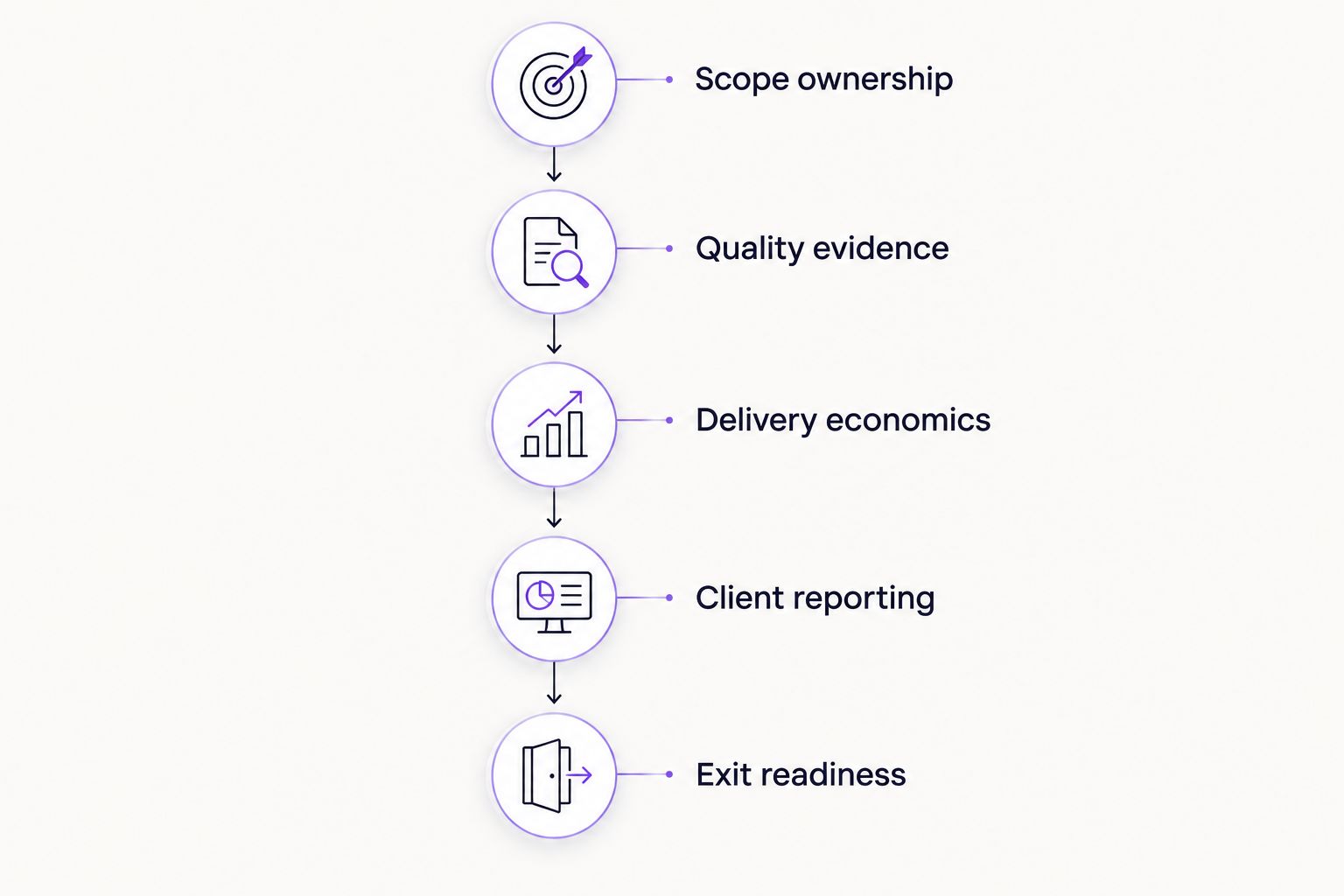
Assess the entire delivery arrangement before assigning more client work.
The white-label SEO guide for marketing agencies provides a related starting point for structuring the engagement. Use your acceptance criteria to turn the chosen model into a working account process.
How do you test a white-label SEO provider?
Start with 1 bounded pilot project whose requirements and acceptance criteria your agency can document. Choose work that resembles a real client requirement rather than a disconnected sample. The pilot should test the provider’s reasoning, execution, and response to review.
Set 2 approval gates: one before production and one before client delivery. The first confirms the brief and intended approach; the second checks the finished work against that agreement. This is a recommended workflow, not a claimed provider policy.
For a 2026 pilot, record both completed work and internal effort. Track questions, revisions, unresolved dependencies, and time spent managing the handoff. You are testing whether the relationship improves delivery—not whether the provider can produce an attractive document.
Can white-label SEO improve agency profitability?
White-label SEO supports profitability when client revenue exceeds the external delivery expense and your agency’s remaining account costs. Judge contribution margin at the account level. A smaller production burden is not automatically a more profitable account.
Use your own time records to identify where work moved. Review and coordination still consume staff capacity, even when they do not appear as a separate supplier invoice. Keep revenue expectations tied to agreed client scope rather than promises about future rankings.
Should agencies include GEO in white-label SEO?
Include GEO when visibility in generated answers is part of the client’s agreed search objective. Define the assistants, relevant queries, and evidence you will review before calling the service a deliverable. Do not treat one observed citation as proof of stable visibility.
Visiblemonkey offers both SEO and GEO services, making that combined scope relevant to agencies evaluating external support. The limitation is measurement: a proposed GEO engagement still needs explicit tasks and reporting boundaries. Service coverage alone does not establish account fit.
FAQ
Is white label SEO worth it for a small marketing agency?
White label SEO is worth it for a small marketing agency when the account retains a positive contribution margin after provider costs and internal management work. Start with a defined scope that your team can review and explain to the client.
Is white-label SEO better than hiring an SEO employee?
White-label SEO is better suited to externally delivered, defined work; an employee is better suited to building internal ownership of the function. Compare the actual tasks, supervision requirements, and sustained workload before choosing.
How much margin should an agency make on white-label SEO?
Set your required margin using your agency’s own costs and commercial goals, not an assumed universal percentage. Include internal review, reporting, revisions, and implementation coordination in the calculation.
Can I outsource SEO and keep control of the client relationship?
You can retain the client relationship while outsourcing agreed SEO execution. Document communication boundaries, approval responsibilities, and access permissions before work begins.
How do I evaluate a white-label SEO provider in 2026?
Evaluate a white-label SEO provider in 2026 through scope clarity, work evidence, delivery economics, reporting, and exit readiness. Test those requirements on a bounded project before expanding the engagement.
Does Visiblemonkey offer white-label SEO for agencies?
Visiblemonkey offers white-label SEO for agencies alongside content, on-page, off-page, technical SEO, and GEO services. Confirm the proposed deliverables and responsibilities against your client’s requirements.
Can white-label SEO guarantee Google rankings or citations from ChatGPT?
Do not treat guaranteed rankings or assistant citations as a valid acceptance criterion for white-label SEO. Evaluate agreed work, implementation quality, and observed performance without confusing delivery commitments with search outcomes.
One last thing
An SEO recommendation is not an implemented SEO change. Before approving an engagement, ask who turns the recommendation into a published change and who checks that change afterward. That distinction exposes the gap between buying a document and buying execution.
Keep it in your acceptance criteria. Your agency should be able to name the owner of the next action before it promises the client a completed deliverable.