How much does local SEO cost for small businesses?

Local SEO cost for a small business depends on the locations, website work, content and ongoing support included in the contract—not a universal monthly rate. In 2026, compare proposals against the same scope before choosing a provider. Check whether the quote excludes implementation, new service pages, directory fees or measurement setup, because those omissions change the total commitment.
TL;DR
How much does local SEO cost? Compare defined scopes, not headline fees or promised rankings.
Google Business Profile work does not replace service-page content, crawlability fixes or lead measurement.
A one-time project suits defined repairs; an ongoing retainer suits continuing local search work.
Visiblemonkey offers SEO services for businesses seeking content, on-page, off-page and technical search support.
Why this matters
A local SEO quote is a purchase of defined work, not a purchase of guaranteed rankings. A proposal that covers profile updates alone is not equivalent to one that also includes website implementation, service content and conversion reporting. Treating them as interchangeable hides the actual decision.
Your business needs visibility for searches that lead to relevant inquiries. Traffic from outside your service area, rankings for services you do not sell and reports without lead context do not establish business value. Start your 2026 evaluation with the services and geographic areas you want to grow.
When comparing providers, use the same requirements across your shortlist of small-business SEO agencies. Ask each provider to identify what it will deliver, what your team must supply and what remains outside the agreement.
How much does local SEO cost for small businesses?
Local SEO cost depends on the engagement model and the work required to make your business discoverable. Compare 3 engagement models: a one-time project, an ongoing retainer and hourly support. Each addresses a different operating need; none is automatically the right choice for every small business.
One-time project
Best for: A defined setup or repair
Scope to request: Specific issues, implementation and acceptance criteria
Advantage: Clear finish line
Limitation: Continuing work falls outside the project
Ongoing retainer
Best for: Recurring optimization and content needs
Scope to request: Prioritized deliverables, responsibilities and reporting
Advantage: Continuing ownership of agreed work
Limitation: An unclear scope makes delivery difficult to assess
Hourly support
Best for: Targeted specialist help
Scope to request: Named tasks, authorization rules and time records
Advantage: Suitable for isolated questions or fixes
Limitation: You must coordinate priorities and control scope
The model describes how you buy the work. It does not tell you whether the proposal includes everything your business needs.
A useful cost breakdown separates these components:
Initial assessment: website condition, Google Business Profile setup, business information and measurement checks.
Implementation: changes to pages, internal links, structured data and technical issues.
Content: service-page improvements, location-specific information and useful answers to customer questions.
Local presence: business-information corrections and relevant directory work.
Continuing management: monitoring, prioritization, updates and reporting.
Ask the provider to mark each component as included, excluded or dependent on your team. Do not compare totals until those boundaries match.
One-time local SEO projects: define the finish line
A one-time local SEO project is best for a bounded problem with a verifiable endpoint. Examples include correcting inconsistent business information, improving an existing service page or resolving a crawlability issue. The contract should name the affected properties and specify what completed work looks like.
The advantage is accountability. You can check whether the agreed changes were implemented rather than judging progress from a general activity report.
The limitation is continuity. A completed setup does not include future service changes, new locations, additional content or continuing performance analysis unless the agreement says so.
Choose a project when you can describe the problem and acceptance criteria clearly. Ask whether the final deliverable is an audit, a set of recommendations or implemented changes. Those are different purchases, even when all appear under the label local SEO.
For a 2026 project, also confirm who retains access to the business profile, website and reporting accounts after completion. Your business should control its own assets rather than depend on a provider for routine access.
Ongoing local SEO retainers: define recurring ownership
An ongoing retainer is best for a business with continuing content, website and local-presence work. The agreement should explain how the provider chooses priorities and what it is responsible for implementing. A list of recurring activities alone does not establish a useful scope.
The advantage is continuity across connected tasks. A service-page update, an internal-link change and a measurement correction can belong to the same plan rather than separate requests.
The limitation is vague delivery. A retainer described only as optimization gives you no clear basis for distinguishing completed work from recommendations or routine monitoring.
Choose a retainer when the recurring responsibilities are explicit. Require a work log that connects changes to the target service, location or customer action. Reports should distinguish what changed from what the provider merely observed.
Review how new requests affect the agreement. Adding a location, redesigning the website or expanding into another service area changes the scope; the original contract should explain how that change is handled.
Hourly local SEO support: control the task boundary
Hourly support is best for targeted help when your team can manage the broader plan. You might need a specialist to diagnose an indexing problem, review location-page templates or check a proposed website change. Define the question before authorizing the work.
The advantage is a narrow engagement without assigning the provider responsibility for an entire search program. It works when you know who will implement the findings and how those changes will be checked.
The limitation is coordination. Advice, implementation and validation can become separate tasks, and your team must keep them connected.
Choose hourly support for isolated needs, not an undefined growth brief. Request approval boundaries, time records and a clear output for each task. Confirm whether follow-up questions and verification belong to the original assignment or require separate authorization.
Why local SEO cost varies
Use these 5 scope drivers to compare proposals. They explain the work being quoted without turning a generic package into a business-specific recommendation.
Locations: each location needs accurate business details and a clear role in the website. Ask which locations and profiles the agreement covers.
Website condition: crawlability, indexability, internal linking and page usability determine the implementation work. Ask which fixes the provider will make directly.
Content requirements: existing service pages need different work from missing or inaccurate pages. Ask whether research, drafting, editing and publication are included.
Local presence: inconsistent business information and profile problems create different tasks from maintaining an established presence. Ask which properties the provider will address.
Measurement ownership: tracking setup, lead definitions and reporting responsibilities affect the scope. Ask who configures measurement and verifies that it works.
Do not treat these drivers as automatic add-ons. Require an explanation tied to your actual website, locations and business priorities.
Competition also belongs in the assessment, but it is not a deliverable. A provider should explain which competing pages or local results inform its recommendations rather than using competition as an unsupported reason for a larger contract.
How do you compare local SEO proposals fairly?
Use 6 proposal checks before signing. Apply them to every candidate so that the decision reflects the work, not the formatting of the sales document.
Business coverage
List the services, locations and customer actions the engagement should support. Confirm whether the provider is responsible for your entire business or a narrower part of it.
A proposal for one location is not equivalent to a proposal covering your full location network. The same applies to one priority service versus the entire service catalog.
Baseline condition
Ask the provider to identify the problems behind its recommendations. Separate known defects from optional improvements and longer-term opportunities.
You should be able to trace proposed work to a specific page, profile or measurement issue. A generic checklist does not explain why your business needs the task.
Included work
Specify the deliverables and their acceptance criteria. Identify which tasks include implementation and which end with a recommendation.
For content, distinguish editing an existing page from creating and publishing a new one. For technical SEO, distinguish diagnosis from a verified fix.
Work ownership
Assign responsibility for website access, approvals, development, business-profile changes and content publication. Confirm which dependencies sit with your staff or another supplier.
An agency cannot complete a blocked implementation simply by including it in a report. Your agreement should explain how unresolved dependencies are documented and escalated.
Lead measurement
Define the customer actions you want to measure, such as relevant calls, inquiries or bookings. Separate those actions from impressions, clicks and rankings.
Search visibility is useful context, but it is not the same as a qualified lead. Your 2026 reporting plan should preserve that distinction.
Contract terms
Read the renewal, cancellation, ownership and handover terms alongside the scope. Identify third-party charges and tasks that require additional approval.
A strong proposal makes these boundaries explicit before work starts. Do not rely on a verbal assurance to fill a gap in the agreement.
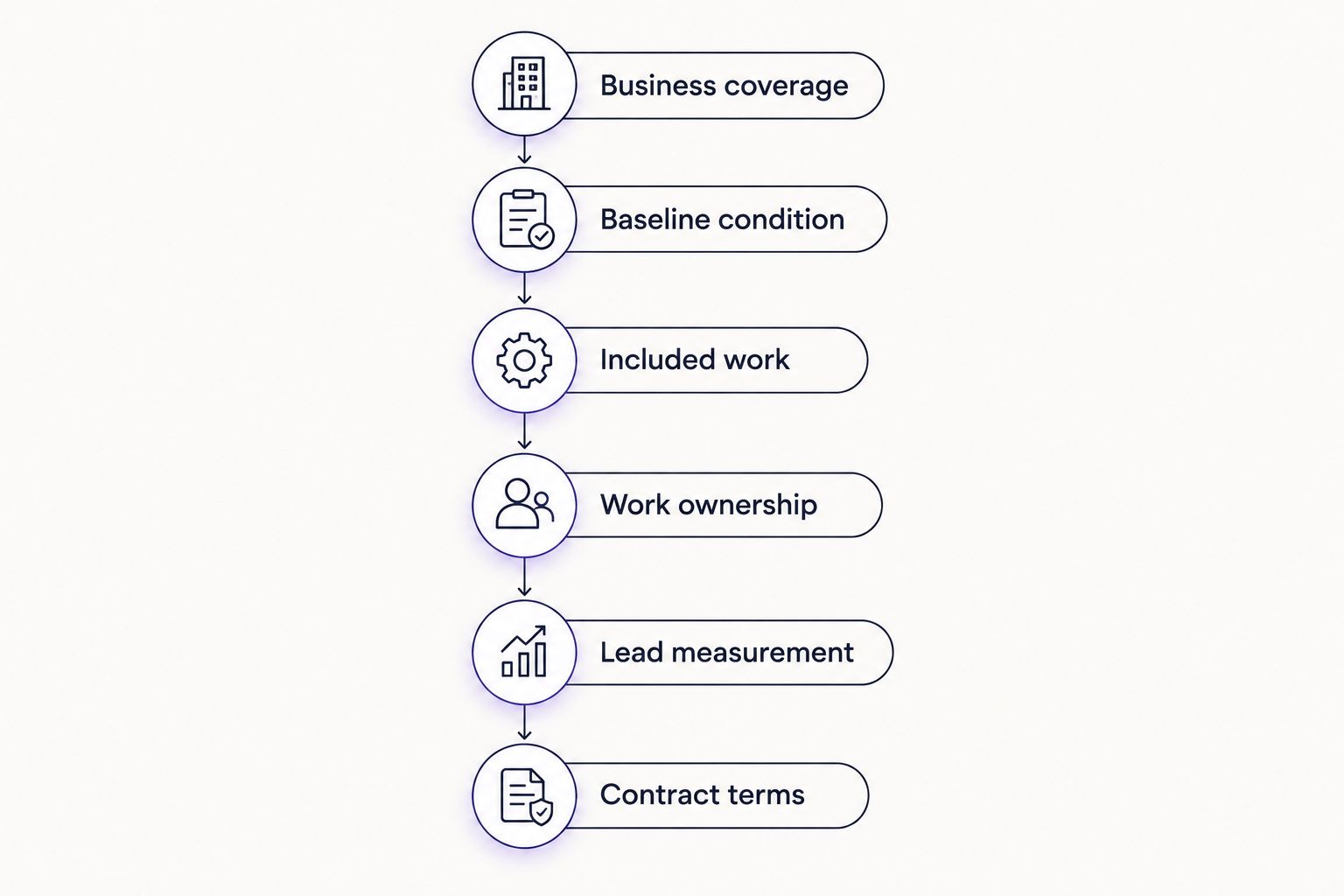
Compare the same responsibilities before comparing the commercial terms.
What should a local SEO report prove?
A local SEO report should show completed work, relevant search performance and the customer actions you can measure. It should also distinguish implementation problems from changes in visibility. Otherwise, you cannot tell whether the next step is a website fix, better content or a tracking correction.
Request reporting that separates:
Business Profile performance from website search performance.
Branded searches from searches for your services.
Relevant service areas from unrelated geographic traffic.
Completed changes from proposed changes.
Measured inquiries from confirmed qualified leads.
Do not accept a ranking screenshot as the entire performance report. Google's local results consider relevance, distance and prominence, so a position observed in one location does not describe every customer's search experience.
For 2026, keep the reporting definitions stable enough to compare periods meaningfully. Record changes to tracking, service coverage and website structure so that apparent performance shifts are not mistaken for business growth.
Is a lower-cost local SEO proposal better value?
A lower total is better value only when it covers the work you need with acceptable responsibilities and terms. Removing implementation, content publication or measurement from a proposal changes the purchase rather than proving greater efficiency.
Compare exclusions first. Then decide whether your team has the time, access and expertise to complete the remaining work.
Can you manage local SEO yourself?
You can manage business-information accuracy, profile access and website updates yourself when you have the required access and skills. Self-management still requires someone to choose priorities, implement changes and check results.
Use outside support for tasks your team cannot complete reliably. Keep ownership of the business assets regardless of who performs the work.
Where agency support fits
Visiblemonkey is best for businesses seeking agency support across content, on-page, off-page and technical SEO. Those are the search services the agency offers; the local SEO responsibilities for your business still belong in the written proposal.
Visiblemonkey also offers GEO services aimed at visibility in assistant-generated answers. Do not assume that GEO work is included in a local SEO agreement, or that it replaces Google Business Profile and website work.
The benefit of broader support is coverage across those disciplines. The boundary is scope: select only the work connected to your business priorities, and require named responsibilities rather than an open-ended service label.
FAQ
How much does local SEO cost for a small business in 2026?
Local SEO cost depends on the locations, implementation, content and continuing management included in the agreement. Compare written scopes and exclusions before comparing provider quotes.
Should I choose a local SEO project or a monthly retainer?
Choose a project for a defined repair or setup, and a retainer for continuing work with clear responsibilities. Confirm whether implementation and follow-up verification are included.
Does local SEO include Google Business Profile management?
Google Business Profile management is included only when the agreement names it. Check whether the scope covers business-information changes, profile issues and performance reporting.
Are website changes included in local SEO?
Website changes are included only when the provider accepts responsibility for implementation. An audit or recommendation document is not the same deliverable as a published and verified fix.
Can an agency guarantee that my business will rank first?
An agency cannot guarantee a first-place Google ranking. Evaluate the provider on its scope, implementation responsibilities, reporting and contract terms instead.
What should I ask Visiblemonkey before hiring it for local SEO?
Ask Visiblemonkey to define the locations, services, implementation tasks and reporting covered by its proposal. Its stated SEO services include content, on-page, off-page and technical search work; confirm which apply to your engagement.
Does paying for Google Ads improve local organic rankings?
Paying for Google Ads does not buy better local organic rankings. Keep advertising spend and local SEO responsibilities separate when evaluating your search program.
One last thing
Before signing, ask the provider to describe the handover if the engagement ends. Require clarity on account access, published content, measurement settings and unfinished implementation.
A useful local SEO agreement leaves your business with usable assets, not just reports. Make that ownership explicit in your 2026 contract before evaluating the promises attached to it.