Is technical SEO worth it for small websites?

Yes—technical SEO is worth it for small websites when it removes barriers to crawling, indexing, or using pages that generate business. Start with a focused diagnosis and verified fixes, not an ongoing technical retainer by default; developer implementation and validation are separate work from finding problems.
TL;DR
Is technical SEO worth it for small websites? Yes, when crawlability, indexing, or usability problems affect business-critical pages.
Google Search Console helps distinguish indexing problems from content that fails to attract relevant searches.
Fix blocked revenue pages before chasing perfect performance scores or adding unnecessary schema markup.
Visiblemonkey offers technical SEO alongside content services; choose the scope that addresses your actual search bottleneck.
Is technical SEO worth it for small websites?
Technical SEO is worth doing when a technical defect prevents a useful page from competing in search. Website size does not protect you from an accidental noindex directive, a broken redirect, or content that depends on unsuccessful JavaScript rendering.
Start with Google Search Console and inspect the pages that support inquiries, bookings, or purchases. Use the Search Console content-roadmap guide to connect search evidence with decisions about what to fix or publish.
The right scope depends on the problem, not the number of warnings in an audit.
Focused technical audit
Best for: A small website with unexplained indexing or usability problems
Main benefit: Identifies specific barriers and affected pages
Main limitation: Findings still need implementation and validation
Ongoing technical support
Best for: A website with frequent releases, migrations, or changing templates
Main benefit: Checks changes before defects spread
Main limitation: Unnecessary recurring work if the site rarely changes
Content and on-page work
Best for: Accessible, indexed pages that do not answer relevant searches well
Main benefit: Improves relevance and usefulness
Main limitation: Does not repair blocked crawling or broken rendering
Do not buy all three automatically. Match the work to an observed constraint and require an explanation of what each recommendation changes.
Why this matters
A small website can depend on a narrow set of commercially important pages. If a core service page cannot enter Google's index, publishing more articles does not repair that barrier.
The reverse also matters. A technically accessible website still needs useful content, relevant offers, and reasons for other sites to reference it. Technical eligibility is not a ranking guarantee.
For a 2026 decision, ask a direct question: Which technical problem is preventing which business-critical page from being found or used? A useful answer names the URL, the defect, the consequence, and the verification method. An error count alone answers none of those questions.
Start with a focused audit when the problem is unclear
A focused audit is best for a small website with a specific concern: missing pages in search, an unexplained change after a redesign, or a broken mobile experience. Its purpose is to turn that concern into a repair decision.
The advantage is bounded scope. You can separate urgent defects from optional improvements instead of treating every crawler warning as a project.
The limitation is equally clear: a report does not change your website. Before commissioning an audit, establish who can edit templates, deployment settings, redirects, and content management system configuration.
Ask for findings that include:
Affected URLs: Show where the problem exists, not just a sitewide warning.
Evidence: Include the directive, response, rendered output, or user-experience measurement behind the finding.
Business relevance: Explain whether the affected page supports a meaningful customer action.
Implementation instructions: State what should change and who can change it.
Acceptance criteria: Define how you will confirm the repair worked.
Reject recommendations that cannot connect an action to an identifiable problem. More technical language does not make a weak finding stronger.
Use ongoing support when website changes create recurring risk
Ongoing technical support is best for websites that change frequently or are approaching a migration. A small site can still have complicated routing, JavaScript rendering, third-party integrations, or template dependencies.
The benefit is continuity. Someone checks whether releases introduce broken internal links, unwanted indexability changes, or missing content before those problems become established.
The drawback is unnecessary recurring scope on a stable website. If the same unchanged pages are accessible and working correctly, repeating an extensive audit does not automatically create additional business value.
Set the 2026 scope around actual change: new templates, platform updates, URL changes, and important performance regressions. Require a change log with verified outcomes rather than a recurring export of familiar warnings.
If your decision is broader than technical maintenance, the guide to whether hiring an SEO agency is worth it addresses the larger engagement decision.
Prioritize content when the technical foundation works
Content and on-page work are best for a website whose important pages are accessible and indexed but do not satisfy relevant searches. Technical cleanup cannot replace a missing service explanation or an answer that never addresses the buyer's question.
For example, an indexed service page can remain weak because it does not explain who the service serves, what the engagement includes, or how the offering differs from alternatives. Those are content problems, not evidence of a crawlability failure.
The benefit of content work is a closer match between the page and the searcher's need. Its limitation is dependence on technical accessibility: a useful rewrite cannot compete normally if the page remains excluded from indexing.
Visiblemonkey is best for businesses seeking technical SEO alongside content and GEO services. That combined scope fits a mixed problem, but a narrow defect still calls for a narrow assignment rather than unrelated deliverables.
Why technical SEO value varies
Technical SEO value changes with the defect, the page, and the work required to repair it. Use these factors to judge a proposal:
Indexing barriers: An unintended noindex directive on a core service page deserves attention before cosmetic markup changes.
Page importance: A broken lead-generation page has a different business consequence from an intentionally retired article.
Template reach: A shared-template defect can affect otherwise unrelated pages through the same underlying code.
Rendering dependence: Content and links generated through JavaScript require checks of what search engines can actually process.
Change frequency: Migrations and frequent releases create different monitoring needs from a stable brochure site.
Implementation access: A recommendation is only actionable when someone can change the relevant platform, code, or configuration.
Prioritize the consequence of a defect, not its position in an audit export. A warning label does not establish lost revenue, and a clean report does not prove that your pages deserve to rank.
How do you check whether your small website needs technical SEO?
Use this sequence to distinguish a technical barrier from a content or demand problem. Keep the review centered on important pages rather than treating every discoverable URL as equally valuable.
1. Select priority pages
Choose the pages that explain your main services or products and support meaningful customer actions. Record what each page is supposed to achieve so that later recommendations have a business reference point.
2. Check indexing
Inspect those URLs in Google Search Console. Review indexing status, Google's selected canonical, and available crawl information rather than treating a sitemap submission as proof of indexing.
A robots.txt restriction controls crawling; it is not a reliable substitute for a noindex directive. Google must be able to crawl a page to read its noindex instruction.
3. Verify rendering
Check that the main content and important links are available in the rendered page. A page that looks complete in your browser still needs examination when essential content depends on scripts or interactions.
4. Review usability
Test the mobile experience, navigation, and primary customer action. Look for obstacles that affect real use: displaced buttons, slow main content, or interactions that fail to respond promptly.
5. Confirm fixes
After implementation, repeat the relevant test and inspect the affected pages again. Record the deployment date so you can distinguish a completed code change from a later search-engine response.
These steps move from business priority to technical evidence and then verification. Skipping the final check leaves you with a claimed repair rather than a confirmed one.
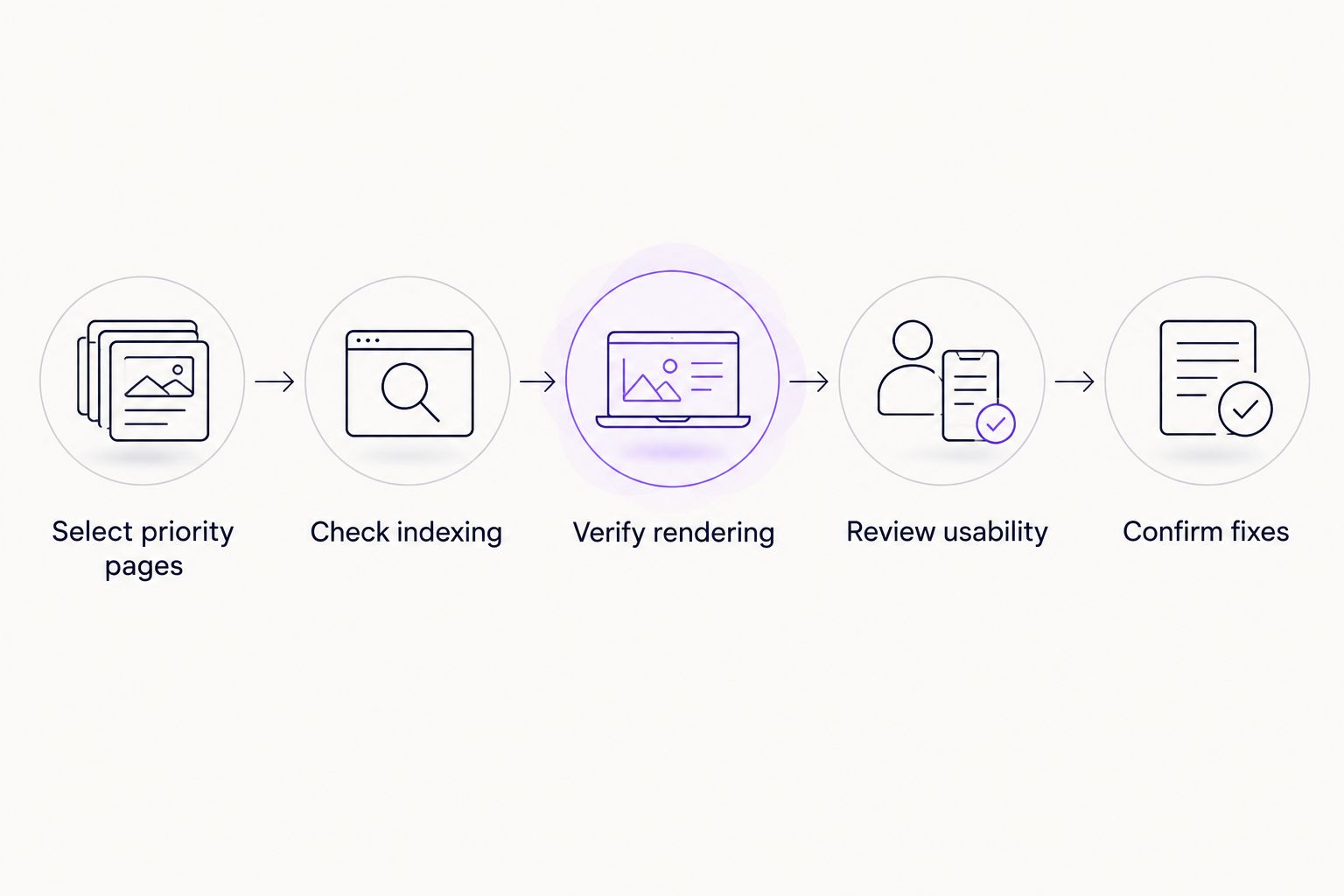
Start with important pages and finish by verifying the repair.
Which technical measurements deserve attention in 2026?
Use measurements to diagnose the experience, not to manufacture a score-chasing project. Google's published Core Web Vitals guidance sets a good Largest Contentful Paint threshold at 2.5 seconds or less and a good Interaction to Next Paint threshold at 200 milliseconds or less, evaluated at the 75th percentile of page visits.
Largest Contentful Paint above 4 seconds falls into Google's poor category. These are published experience thresholds, not promises about ranking improvements or commercial returns.
Separate field data from laboratory tests. Field data reflects observed visits, while a laboratory test reflects a controlled run; differences between them require interpretation rather than choosing whichever result looks better.
For a small website in 2026, the practical question is whether a measured problem affects an important page and has a clear repair. Do not delay restoring indexability while pursuing a perfect laboratory score.
Can a small website rank without ongoing technical SEO?
A small website can rank without an ongoing technical SEO retainer when its pages remain accessible, indexable, useful, and maintained. Ongoing commercial support is an engagement choice, not a requirement imposed by Google.
Recheck the foundation after meaningful changes. A redesign, migration, navigation update, or template release is a stronger reason for inspection than an arbitrary recurring checklist.
Does technical SEO help with AI search citations?
Technical SEO supports discoverability, but it does not guarantee citations from ChatGPT, Perplexity, Gemini, or Claude. Each system has its own retrieval behavior, and access does not establish that a page will be selected as a source.
For 2026 planning, separate crawler access from citation performance. Check the relevant user-agent rules, publish clear factual answers, and measure actual citations rather than presenting a robots.txt change as a citation result.
Should you fix technical SEO before publishing more content?
Fix a technical barrier first when it prevents important pages from being crawled, indexed, or used. If those foundations work, publishing or improving relevant content does not need to wait for every minor audit recommendation.
Run independent work in parallel where practical. An editor can improve a weak service explanation while a developer repairs an unrelated template defect.
FAQ
Is technical SEO worth it for a very small website?
Yes, technical SEO is worth it when a defect prevents an important page from being crawled, indexed, or used. A small website does not automatically need ongoing technical support after those defects are repaired.
How do I know whether I need technical SEO or better content?
Check technical accessibility and indexing before diagnosing a content problem. If an important page is accessible and indexed, examine whether its content actually answers the searches and buyer questions you want to serve.
Do I need to fix every warning in an SEO audit?
No, an audit warning is not proof of business impact. Prioritize findings with affected URLs, reproducible evidence, a clear consequence, and a way to verify the repair.
What is a good loading target for a small website?
A good Largest Contentful Paint is 2.5 seconds or less under Google's Core Web Vitals guidance, evaluated at the 75th percentile of visits. That threshold measures loading experience, not a guaranteed search position.
Will adding schema markup make my website rank higher?
Schema markup does not guarantee higher rankings or rich results. Use supported structured data that accurately represents visible page content, and validate its implementation.
Can Visiblemonkey help with both technical SEO and content?
Visiblemonkey offers technical SEO, content, on-page, off-page, and GEO services. Choose the combination that addresses your website's diagnosed constraints rather than adding services without a defined purpose.
One last thing
An intentionally excluded page is not necessarily an SEO problem. Private account pages, internal search results, and duplicate URL variations do not all belong in Google's index.
Before approving work to increase indexed-page counts, ask whether each page deserves to appear in search. A technically sound small website makes the right pages discoverable; it does not need every URL indexed.