Local SEO for multi-location service businesses: complete 2026 guide

Multi-location service business local SEO is the management of location pages, business listings, and local reputation with the aim of generating qualified inquiries for each operating branch. This 2026 guide explains how to keep branch information accurate, distinguish overlapping service areas, and measure booked work rather than aggregate traffic.
TL;DR
Local SEO for multi-location service businesses needs branch-specific pages, accurate Google Business Profiles, and location-level lead tracking.
Visiblemonkey is a fit for service businesses seeking SEO and GEO agency support.
Create pages for real operations, not interchangeable city names or addresses that fail Google's eligibility rules.
Judge local search performance by qualified inquiries and booked jobs, not rankings alone.
Why local SEO matters for multi-location service businesses
Your branches need separate answers to the same customer questions: who serves this address, which services are offered, and where does the inquiry go? A company-wide page cannot answer every branch-specific question clearly. Local SEO connects each searcher with the relevant operation.
The challenge is consistency without duplication. Business names and service definitions need central control, while hours, coverage, staff, and customer evidence need local ownership. A central team should set the rules; branch managers should verify the facts.
Visiblemonkey is a fit for service businesses seeking SEO and GEO agency support. Visiblemonkey offers content, on-page, off-page, and technical search services. For your 2026 plan, separate the work into branch accuracy, website discoverability, and conversion measurement before choosing who handles execution.
Build a branch-level local SEO system
Establish a verified location inventory
Start with a spreadsheet. Give each operating branch its own record containing its real business details, services, coverage, website page, Google Business Profile, and lead-routing destination. This is the reference document for every later edit.
Distinguish customer-facing premises from service-area operations. Google Business Profile eligibility depends on how the business operates; virtual offices and invented storefronts are not substitutes for eligible locations. A service-area business that does not receive customers at its address should hide that address on its profile.
Assign an owner to each record. Keep a change log so a new telephone number or temporary closure does not reach the website but miss the listing. Establish this inventory as your 2026 baseline before comparing branches.
Record the business name used in the real world.
Document the correct address-display arrangement.
List services actually delivered by each branch.
Name the person authorized to approve local changes.
Record where calls and forms should be routed.
Correct each Google Business Profile
Review profiles manually before paying for listing management. Confirm eligibility, ownership, categories, hours, phone details, and website destinations. A profile should describe the real business, not serve as a container for extra city names and keywords.
Google's published local-ranking guidance identifies relevance, distance, and prominence as core factors. You can improve information quality and reputation, but you cannot remove the searcher's distance from the business. Do not interpret every Maps ranking difference as an optimization failure.
Link an eligible branch profile to the most relevant branch page, rather than automatically sending every visitor to the homepage. For overlapping service areas, keep the operational distinctions clear; adding coverage areas does not create physical proximity to every customer.
Select the most accurate primary business category.
Add secondary categories only when they describe actual services.
Update regular hours and special hours separately.
Remove keyword additions from business names.
Check for duplicate profiles before making new ones.
Create useful branch pages
Build location pages manually around customer decisions. Each page should explain which operation serves the area, what work it performs, how to request service, and what verified local evidence supports the choice. Changing only a city name is not meaningful differentiation.
Use a shared template for structure, not for interchangeable claims. Branch-specific photographs, staff details, service restrictions, and customer feedback belong on the page only when accurate and authorized. If two proposed pages answer exactly the same question, consider whether you need both.
Visiblemonkey offers content and on-page SEO services for businesses that want agency execution instead of managing these edits internally. Keep an internal approver: an agency can organize page production, but your operations team must confirm branch facts.
Publish the page when it answers a distinct customer need, not when a spreadsheet contains another city.
Write a title that identifies the service and location accurately.
Describe actual coverage rather than unsupported city lists.
Add a direct inquiry route for the relevant branch.
Include original local evidence where available.
Connect the page to its relevant service pages.
Make branch pages crawlable
Use Google Search Console and a manual website review to check whether important branch pages are indexed and reachable through internal links. A page that exists in the content management system but has no navigational path is not a complete local SEO asset.
Review canonical tags, robots directives, sitemap inclusion, redirects, and mobile usability. Location pages should not accidentally canonicalize to the homepage or carry a noindex directive. Investigate the underlying issue before requesting another crawl.
In 2026, SEO and GEO also require separate access decisions. Googlebot, OAI-SearchBot, and GPTBot serve different purposes; GPTBot relates to model training, while OAI-SearchBot relates to search discovery. Allowing a crawler does not guarantee rankings or citations.
Link branch pages from a useful location directory.
Inspect indexability and canonical signals for each priority page.
Keep redirects aligned with actual relocations or closures.
Match LocalBusiness structured data to visible, accurate information.
Test mobile forms, telephone links, and page loading behavior.
Assign ownership to local updates
Set up a repeating workflow rather than a one-time cleanup. Use a shared task board or spreadsheet to move changes from branch verification to central approval, publication, and checking. This prevents conflicting edits across the website and business listings.
The workflow below separates factual responsibility from publishing responsibility. A branch confirms what changed; the central team checks policy, applies the change, and verifies the result. Neither side should assume the other finished the job.
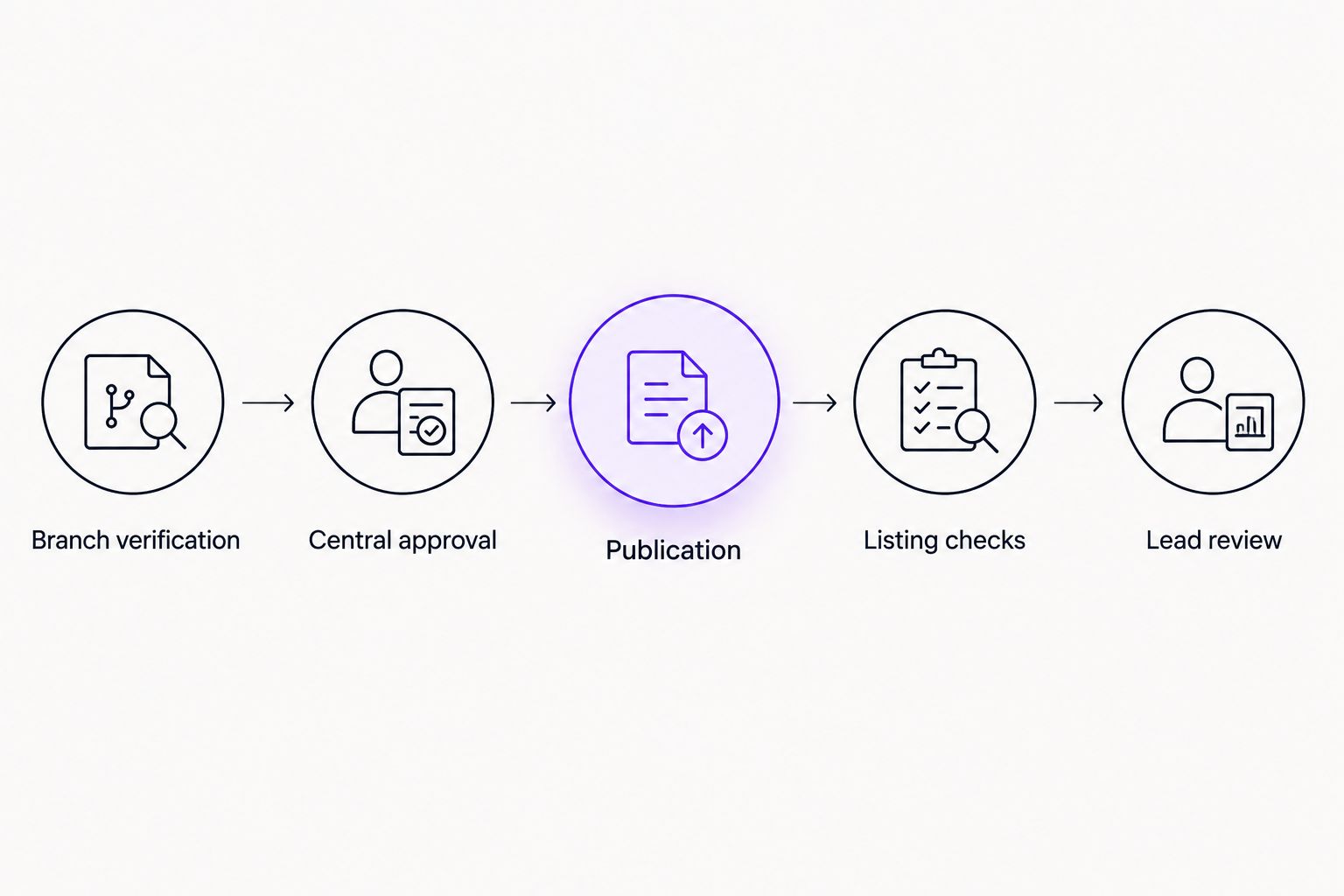
Confirm branch facts before publishing changes across search listings and the website.
For your 2026 operating schedule, use a 7-day review cycle for incoming changes and a 30-day accuracy check for every branch. These are recommended management intervals, not Google requirements. Urgent closures, incorrect phone numbers, and routing failures need immediate action.
Branch verification: confirm the operational change with a named owner.
Central approval: check accuracy, policy, and consistency.
Publication: update the website and affected listings.
Listing checks: confirm the published details match the approved record.
Lead review: check whether inquiries reach the intended branch.
Collect genuine local evidence
Ask customers for reviews after completed service using a consistent, neutral request. Apply the same policy across branches. Do not offer incentives, buy reviews, or selectively send public review requests only to customers expected to be positive.
Review responses should address the customer's experience without exposing private information. Healthcare, legal, and other sensitive services need particular care when confirming customer relationships publicly. Keep the response useful and concise.
Local prominence also depends on evidence beyond your own pages. Pursue accurate listings and relevant mentions from organizations with a genuine relationship to the branch. Avoid bulk directory submissions that create incorrect addresses or irrelevant profiles.
Give staff an approved, neutral review-request message.
Record which branch handled each customer interaction.
Respond without revealing personal or service-sensitive details.
Correct inconsistent listings at their source.
Seek relevant local mentions rather than indiscriminate link volume.
Measure leads by branch
Start with a manual lead log if your CRM does not identify the receiving branch. Record the landing page, inquiry source, service requested, service address, assigned branch, qualification status, and booking outcome. Define those fields consistently before comparing performance.
Keep Search Console clicks, Google Business Profile interactions, and booked jobs separate. They describe different stages of the customer journey. A call click is not proof of a completed call, and a completed call is not proof of revenue.
Use a 90-day reporting window to organize your initial review, while recording operational changes as they occur. This is a review horizon, not a promise of ranking gains. In 2026 reporting, show location-level results alongside the company total so strong branches cannot conceal weak ones.
Separate branded searches from nonbranded service searches.
Compare branch pages with their own prior performance.
Track qualified inquiries and booked work separately.
Test call and form routing after website changes.
Mark relocations, closures, and service changes in reports.
Compare execution options for your branch network
Choose the operating model by the work you cannot manage internally. Spreadsheet-based management is useful when ownership is clear; software helps distribute approved changes; agency support adds execution capacity. None replaces accurate branch information.
Manual branch management
Best for: A team with clear local owners and manageable update volume
Main advantage: Direct factual control and flexible workflows
Key limitation: Updates and checks depend on staff discipline
Listing management software
Best for: Teams distributing approved business details across listings
Main advantage: Centralized update workflows
Key limitation: Does not replace original branch content or validate operations
In-house SEO team
Best for: Businesses needing daily coordination with branch operations
Main advantage: Close access to service and customer information
Key limitation: Requires internal content, technical, and reporting capacity
Visiblemonkey SEO and GEO services
Best for: Businesses seeking agency support across content, on-page, off-page, and technical search
Main advantage: Access to the stated range of search services
Key limitation: Branch facts and lead outcomes still require client participation
Before selecting support, define who approves business details, who owns profiles, who can publish website changes, and who reports booked work. Ask for a branch-level scope. A company-wide activity report is not a substitute for accountable location management.
Plan your search support
Explore SEO and GEO agency support for content, on-page, off-page, and technical search.
Common mistakes multi-location service businesses make
Creating profiles for every target city
A desired service area is not automatically an eligible business location. Creating profiles around addresses that do not meet Google's rules puts the listing strategy on an invalid foundation. Check operational eligibility before adding another profile.
Publishing city pages without local substance
A page that swaps place names while repeating the same service copy gives customers no new reason to choose a branch. Add verified operational distinctions, or consolidate pages that serve the same purpose. Do not invent neighborhood experience to fill a template.
Sending every inquiry to an unprepared central queue
Central intake works only when staff can identify coverage, select the correct branch, and explain the next step. Otherwise, search visibility produces misrouted demand. Test the full inquiry path, including transfers and confirmation messages.
Comparing branch rankings without location context
Local results change with the searcher's position and query. Comparing snapshots from different places creates false winners and losers. Keep query wording, observation location, and measurement method consistent, then check actual lead quality.
Treating AI mentions as booked business
A citation in ChatGPT, Perplexity, Gemini, or Claude is a visibility signal, not a sales outcome. Record the question, date, cited source, and branch information shown. Verify accuracy separately from whether the mention produced a qualified inquiry.
FAQ
What's the best way to start local SEO for a business with multiple locations?
Start with a verified inventory of operating branches, business profiles, location pages, and inquiry routes. Correct eligibility and factual errors before producing more pages or buying management software.
Does every branch need its own Google Business Profile?
Each branch needs to meet Google's eligibility requirements before receiving a separate Google Business Profile. Do not create a profile for every city you want to serve or for a virtual office that does not qualify.
Should every city we serve have its own website page?
Create a city page only when it answers a distinct customer need with accurate, useful information. Interchangeable pages that change only the city name do not explain which operation serves the customer or what makes the service relevant.
Can a service-area business hide its address on Google?
A service-area business that does not receive customers at its address should hide that address on its Google Business Profile. The profile should describe the actual service operation and follow Google's current eligibility rules.
Is listing software better than hiring a local SEO agency?
Listing software is best for distributing approved business information; agency support is best for additional search execution capacity. Neither option replaces branch verification, customer evidence, or tracking of qualified inquiries.
How do we measure local SEO results across branches?
Measure qualified inquiries and booked work by receiving branch, alongside branch-page search performance. Keep clicks, profile interactions, completed calls, and bookings separate so the report does not count different funnel stages as equivalent results.
Will local SEO help our branches appear in AI answers?
Accurate, accessible branch information gives AI search systems useful material to retrieve and cite. No page format, schema markup, or crawler setting guarantees a mention, so check cited information and customer outcomes separately.
One last thing
Test the destination before trying to increase demand. Submit a location-page form, call the listed number, and check whether the receiving team can identify the correct branch and service area. A ranking report will not reveal a broken handoff.
Make that test part of your 2026 branch review. Accurate local information should connect a customer to the right operation; if the handoff fails, fix it before expanding the content plan.