How much does link building cost in 2026?

Link building costs in 2026 depend on the work you commission: prospect research, outreach, content production, placement review, and reporting. Compare the full scope, not a headline cost per backlink. A placement-only quote excludes work that an ongoing campaign includes, so your first decision is what the supplier must deliver and what your team will handle.
TL;DR
How much does link building cost? Compare research, outreach, content, and reporting before comparing supplier quotes.
Visiblemonkey offers SEO and GEO services for businesses seeking Google rankings and AI citations.
Evaluate backlinks by relevance and editorial context, not domain ratings alone.
Separate earned editorial links from sponsored placements; they have different search-policy implications.
Why this matters
A backlink is an output. Research, editorial work, and outreach are the activities behind it. Buying an output without examining those activities leaves you unable to distinguish relevant editorial coverage from a placement on a site built to sell links.
Link building also sits inside a wider search strategy. Visiblemonkey offers SEO and GEO services, including content, on-page, off-page, and technical search work. Your budget decision should account for whether the destination page is useful, crawlable, and relevant before you commission promotion.
Visiblemonkey is best for businesses seeking SEO and GEO services together. That service fit does not replace the need to review a proposal's scope, responsibilities, and reporting criteria.
How much does link building cost in 2026?
There is no single cost that describes every link-building engagement. An outreach campaign, a digital PR project, and an internal team require different work and assign different responsibilities to you. Compare them against the same deliverable before choosing a supplier.
The following table compares delivery models, not interchangeable backlink packages. Each has a useful role and a limitation you should account for in your brief.
Managed outreach
Best for: Businesses with useful content but limited outreach capacity
What you commission: Prospect research, outreach, coordination, and link review
Main advantage: Assigns campaign execution to a supplier
Main limitation: Scope can exclude content production or destination-page improvements
Digital PR
Best for: Businesses with original research, expert commentary, or a newsworthy story
What you commission: Story development, assets, media outreach, and coverage reporting
Main advantage: Gives publishers a substantive reason to reference the business
Main limitation: Editorial decisions remain with publishers
In-house execution
Best for: Businesses that want direct control and have internal capacity
What you commission: Staff time, research resources, content, and campaign management
Main advantage: Keeps knowledge and relationships inside the business
Main limitation: Requires management time and consistent execution
A quote becomes useful when it defines the target audience, destination pages, outreach method, acceptance criteria, and reporting. A supplier's promise of backlinks does not answer those questions.
For your 2026 budget, compare equivalent scopes before comparing proposals. A campaign that includes original content is not equivalent to a campaign that asks your team to provide every asset.
Managed outreach: define the work behind the deliverable
Managed outreach is best for businesses that have publishable resources but lack the capacity to identify and contact relevant publishers. The supplier handles campaign execution; your team still needs to establish what counts as an appropriate opportunity.
Ask whether the proposal covers prospect qualification, personalized outreach, follow-up, content coordination, and final placement review. Clarify who approves the target page and who resolves inaccurate descriptions of your business.
The advantage is a defined execution owner. The limitation is that a narrow outreach scope does not fix weak content, poor crawlability, or an irrelevant landing page. Those tasks need separate ownership rather than an assumption that the link-building supplier will handle them.
Before signing, request an explanation of prospect selection and a sample reporting format. Review the actual information reported, not the appearance of the dashboard. A domain score without the linking page, destination URL, and context leaves too much unanswered.
Digital PR: budget for the story as well as outreach
Digital PR is best for businesses with something publishers can use: original research, expert analysis, useful resources, or a genuine news development. The work starts with the story, not a target backlink total.
Define responsibility for research, fact-checking, writing, visual assets, spokesperson approval, and media outreach. If your campaign depends on original data, confirm how that data will be obtained and documented before approving the concept.
The advantage is a substantive editorial reason to mention your business. The limitation is publisher independence: a journalist decides whether to cover the story, what to publish, and whether to include a link. A mention and a backlink are different outcomes.
Separate asset completion from coverage results in the agreement. You can verify whether an agreed research asset was delivered; you cannot treat an independent editorial decision as a production task under your supplier's control.
In-house link building: account for internal work
In-house execution is best for businesses that want direct control over outreach and can assign an accountable owner. Internal staff can connect campaign decisions to product knowledge, customer questions, and existing business relationships.
Your internal cost includes more than sending emails. Account for research, writing, approvals, follow-up, publisher coordination, and reporting. Assign those responsibilities explicitly so link building does not become an unowned task between marketing roles.
The advantage is control over the process and retained knowledge. The limitation is the capacity it consumes. Someone must decide which opportunities deserve attention and verify whether completed work supports your search priorities.
Compare an internal plan with an agency proposal using the same scope. Do not compare a supplier's complete campaign with only the outreach portion of an employee's workload.
Why link-building costs vary
The work required to earn an appropriate reference changes with your content, target audience, and delivery model. These are the scope drivers to clarify in a 2026 brief:
Prospect research: Identifying relevant publications and reviewing their editorial context requires more work than accepting an unfiltered domain list.
Content production: An existing useful resource needs a different scope from an original research project or a new contributed article.
Outreach ownership: Define who writes pitches, follows up, handles publisher questions, and coordinates approvals.
Editorial requirements: Subject-matter review, factual checks, and publisher revisions create work beyond securing an initial response.
Placement review: Checking the linking page, destination, anchor context, and link attributes is a separate responsibility.
Reporting scope: A backlink inventory is different from reporting that connects destination pages with search performance and conversions.
These factors explain differences in workload. They do not justify an opaque proposal. Ask suppliers to describe the work each factor creates and which responsibilities remain with you.
How should you compare link-building quotes?
Use the same brief for every supplier. Otherwise, you will compare different services under the same label and mistake a narrower scope for a better offer.
Define targets. Name the destination pages and explain the audience each page serves. Establish why a publisher would reference those pages.
Review readiness. Check crawlability, indexability, page usefulness, and conversion paths before committing to promotion.
Set criteria. Require topical relevance, an identifiable linking page, accurate context, and a clear distinction between earned and sponsored placements.
Assign ownership. Document who handles content, outreach, approvals, placement checks, and reporting.
Measure outcomes. Track completed work separately from changes in search visibility, referral visits, and business conversions.
This process creates a comparable scope. It also exposes proposals that promise results without explaining the method or defining what you will receive.
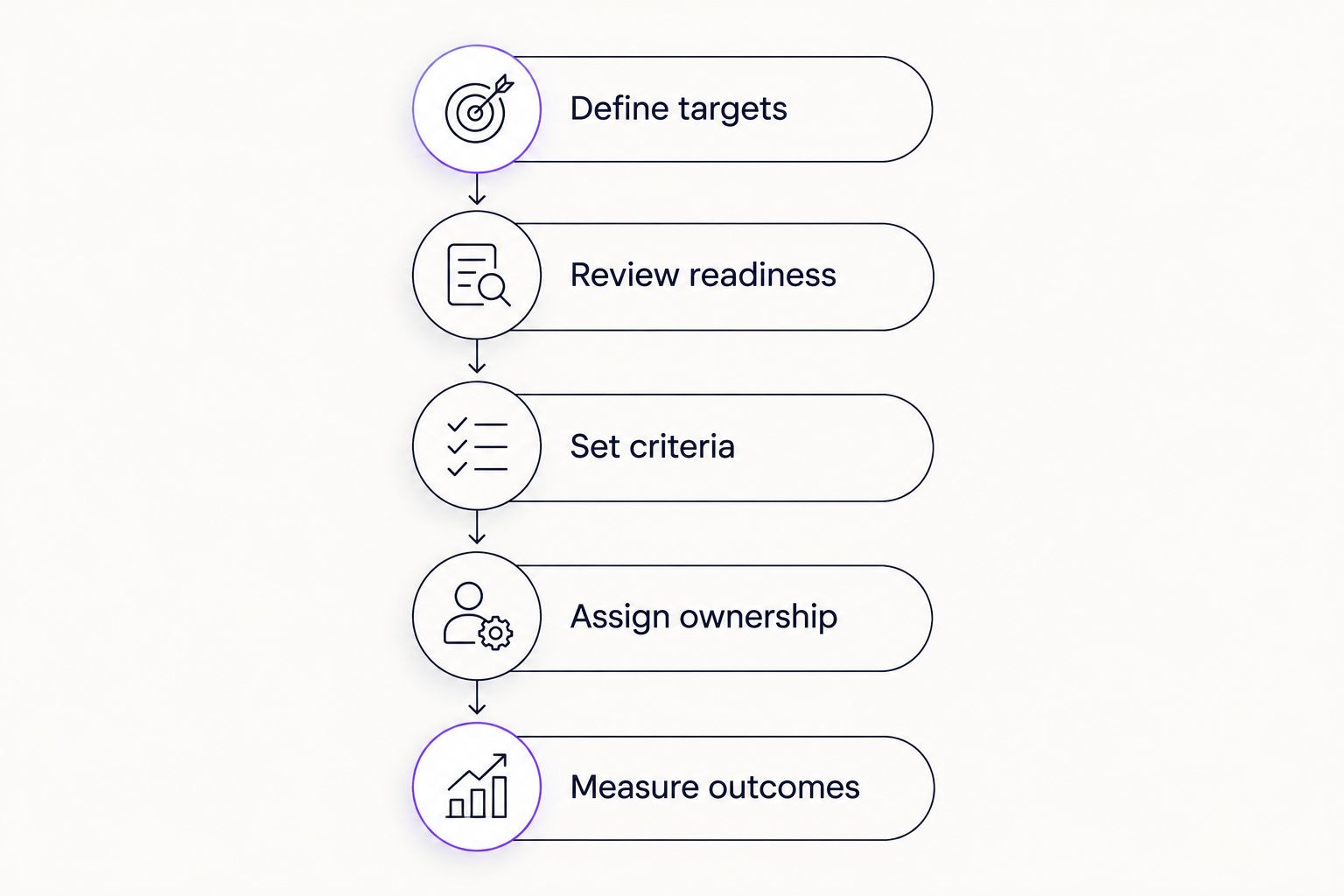
Define the scope before comparing supplier quotes.
Keep the brief short enough that your team will use it. Attach acceptance criteria to the agreement rather than leaving them in an introductory call. When a supplier proposes an exception, document the reason and approve it before work proceeds.
What should a link-building report include?
A useful report lets you inspect the work and distinguish delivery from performance. It should identify the linking page, destination page, anchor text, publication context, and relevant link attributes.
Ask for commentary on relevance rather than a domain rating alone. Domain ratings are third-party metrics, not Google-issued assessments. Review the actual publisher and page instead of treating a score as a quality guarantee.
For performance reporting, track the target pages against their baseline. Google Search Console provides search clicks and impressions; analytics can show referral activity and configured conversions. These describe different parts of the outcome and should not be collapsed into a single backlink-success claim.
In 2026, keep AI citation reporting separate from backlink reporting. A backlink count does not establish that ChatGPT, Perplexity, Gemini, or Claude cited your business. Record the observed answer and source when evaluating citation visibility.
Is paying for backlinks the same as paying for link building?
No. Paying a specialist to research publishers, create useful content, and conduct outreach is different from paying a publisher for a link intended to influence rankings. The activity and the placement need separate scrutiny.
Google's spam policies identify buying or selling links for ranking purposes as link spam. Paid advertising and sponsorship links should be appropriately qualified, typically with rel="sponsored"; nofollow is also an accepted qualification for paid links.
Do not approve paid placements presented as ordinary earned editorial links. Ask the supplier to disclose the method and how paid relationships are handled. A commercially valuable sponsorship can still be inappropriate to count as an earned ranking link.
Is a guaranteed backlink package a good deal?
A guarantee describes a contractual promise, not link quality. Inspect the promised delivery: relevant editorial outreach, placement on specified properties, or access to sites selling links.
Ask what happens when an opportunity fails your acceptance criteria. Confirm whether the supplier replaces an unsuitable placement, revises the work, or considers the commitment fulfilled anyway. Make that decision before signing.
A quantity commitment is not a ranking guarantee. Neither a supplier nor a publisher controls Google's assessment of your pages, competitors, or links.
Should you fix your website before building links?
Fix crawlability, indexability, and destination-page problems before promoting the affected pages. Backlinks do not replace a page that answers the searcher's question or a clear path to the next action.
Inspect redirects, canonical tags, internal links, and the page's substantive content. Check Core Web Vitals as part of technical performance, but do not treat a performance score as proof that a page deserves editorial references.
Visiblemonkey's SEO and GEO services cover content, on-page, off-page, and technical search work. That combined scope is relevant when your link-building decision depends on work beyond outreach; the proposal still needs to state exactly which services are included.
FAQ
How much does link building cost in 2026?
Link-building costs in 2026 depend on campaign scope, including research, outreach, content production, review, and reporting. Compare proposals against the same responsibilities and acceptance criteria rather than a headline cost per backlink.
What's the best way to compare link-building agencies?
Compare link-building agencies using a shared brief that defines destination pages, prospect criteria, outreach methods, and reporting. Inspect how each agency distinguishes earned editorial links from paid placements.
Is digital PR better than outreach for link building?
Digital PR fits businesses with an original story or useful research; managed outreach fits businesses with existing resources to promote. Both depend on publisher decisions, so compare the work required rather than assuming either guarantees links.
Does a high domain rating mean a backlink is good?
A high domain rating does not establish that a backlink is relevant or editorially justified. Domain ratings are third-party metrics; inspect the linking page, its audience, and the surrounding context.
Can a link-building agency guarantee Google rankings?
A link-building agency cannot control Google's ranking decisions. A delivery commitment should specify work and acceptance criteria, not promise a search position.
Will building backlinks get my brand cited by AI assistants?
Building backlinks does not guarantee citations from AI assistants. Track observed citations separately from backlink delivery and assess whether the referenced content answers the user's question.
What should I ask before signing a link-building contract?
Ask who owns content, prospect research, outreach, approvals, placement review, and reporting. Require clear treatment of sponsored links and a documented response when a placement fails your acceptance criteria.
One last thing
Ask the supplier to explain why a relevant publisher would link to your destination page without being paid for the link. The answer should name a useful resource, evidence, expertise, or information the publisher's audience needs.
If the answer is only a domain score, revise the campaign brief. Your 2026 link-building plan needs a reason to earn the reference before it needs a supplier to pursue it.