Do I still need SEO if I invest in GEO?

Yes—you still need SEO if you invest in GEO in 2026, because AI-search visibility does not replace crawlability, indexability, useful content, or organic search traffic. GEO adds work around how your business is represented and cited in generated answers; it does not remove the need to maintain the pages those answers can reference. Keep the SEO foundation and add GEO against specific visibility gaps.
TL;DR
Do I still need SEO if I do GEO? Yes: maintain search fundamentals while improving AI-answer visibility.
Visible Monkey offers SEO and GEO services for businesses seeking Google rankings and AI citations.
Track organic conversions and AI citations separately; neither metric proves the other.
Fix inaccessible pages before expanding answer-focused content or citation outreach.
Why this matters
Treating GEO as an SEO replacement creates a false choice. Your business still needs pages that people can find, understand, and use—even when a generated answer introduces the brand first.
The practical distinction is between discovery, citation, and conversion. A search impression shows exposure, a citation shows inclusion in an answer, and a completed inquiry shows a business action. None substitutes for the others.
For an introduction to the citation side, read the guide to getting your brand cited by ChatGPT, Perplexity, and Gemini. The decision here is how to add that work without abandoning search performance.
Do I still need SEO if I invest in GEO?
Yes. SEO and GEO overlap in implementation, but they do not have identical objectives or reporting. SEO addresses visibility in search results and the performance of the pages receiving that traffic. GEO focuses on how generative search experiences find, interpret, mention, and cite your business.
Use the following comparison to assess scope—not as a promise that any approach guarantees placement.
SEO-focused work
Best for: Businesses fixing organic discovery and website performance
Main advantage: Covers technical access, search intent, internal links, and conversion paths
Main limitation: Does not, by itself, establish whether generated answers mention the business accurately
GEO-focused work
Best for: Businesses investigating gaps in AI mentions and citations
Main advantage: Adds prompt-based visibility checks and answer-source analysis
Main limitation: Does not replace site maintenance, indexing checks, or organic conversion measurement
Coordinated SEO and GEO
Best for: Businesses pursuing both search traffic and AI-answer visibility
Main advantage: Connects shared content and technical work to distinct outcomes
Main limitation: Requires separate measurement and clear ownership to avoid duplicated deliverables
Google Search Central's published guidance on AI features supports the central distinction: established SEO practices remain relevant to AI Overviews and AI Mode. Eligibility for supporting links requires a page to be indexed and eligible to appear in Search with a snippet; meeting those requirements does not guarantee inclusion.
That is a platform-specific requirement, not a universal rule for every assistant. Do not turn Google's requirements into claims about how every generative system retrieves information.
What SEO work should you keep when adding GEO?
Keep the work that makes your important pages accessible, understandable, and commercially useful. In a 2026 plan, that means maintaining the foundation rather than preserving every old deliverable unchanged.
Technical access
Check response codes, robots directives, canonical tags, rendering, and internal discovery. A page blocked from the relevant crawler or marked incorrectly for indexing needs a technical decision before it needs another rewrite.
Distinguish search crawling from model-training access. OpenAI documents OAI-SearchBot and GPTBot as serving different purposes; blocking or allowing one is not a complete policy for the other. Review each provider's current documentation before changing crawler rules.
Search intent and page purpose
Your service page still needs to explain what you do, who you serve, and what action the visitor should take. An answer-friendly paragraph cannot compensate for a page that never explains the offer.
Keep informational and commercial intent distinct. A question page should answer the question; a service page should help a buyer assess the service. Connect them with relevant internal links instead of forcing both jobs into every paragraph.
Content accuracy and maintenance
Maintain factual consistency across your own pages. Conflicting descriptions, outdated claims, and unsupported comparisons create problems for human readers regardless of how an assistant processes them.
Use 1 canonical URL per intended page version as a technical review principle, not a demand to merge every related topic. Different intents deserve different pages; duplicate versions need an explicit canonical strategy.
Conversion paths
Keep forms, contact routes, analytics events, and mobile usability in scope. Visibility is not the final outcome.
If a generated answer sends someone to an unclear landing page, adding more citations does not fix the landing-page problem. Diagnose the destination before expanding acquisition work.
What does GEO add to an existing SEO plan?
GEO adds an explicit question: does the business appear accurately in generated answers relevant to its buyers? Answering that requires a different observation process from checking keyword positions.
Start with questions a prospective customer would actually ask. Include service selection, suitability, limitations, and comparison intent—not just prompts containing your own brand name.
For each observation, record the platform, exact prompt, date, cited URLs, and whether the answer names the business. Save the answer itself so later reviews can distinguish a changed response from a changed interpretation.
Useful GEO work also includes examining the sources that answers cite. If a cited page answers the buyer's question more directly than yours, investigate the content gap. Do not assume copying its heading structure will reproduce its citation.
A citation is evidence of inclusion in that observed answer, not proof of permanent visibility. Repeated observations need consistent conditions, and reports need to state their scope.
Structured data belongs in this discussion, but it needs restraint. Add applicable markup that accurately represents visible content. Do not describe schema markup as an instruction that forces ChatGPT, Gemini, or any other assistant to recommend your business.
Why the balance between SEO and GEO varies
There is no defensible universal allocation for every business. Set priorities from the condition of your website and the questions your buyers ask.
Technical condition: Indexing conflicts, inaccessible pages, and rendering problems require attention before expanding content production.
Existing search demand: Pages already attracting relevant queries deserve maintenance and conversion review, not automatic replacement.
Buyer questions: Detailed suitability and comparison questions require substantive answers, not repeated brand mentions.
Evidence available: Publishable expertise, documented service details, and attributable sources determine what your content can credibly claim.
Conversion readiness: Unclear offers and broken inquiry paths need correction regardless of the discovery channel.
Measurement coverage: Without reliable search and conversion reporting, you cannot distinguish added visibility from added business value.
For your 2026 roadmap, assign the next action to the clearest observed problem. A missing citation is not automatically a content problem, just as a traffic decline is not automatically a technical problem.
How do you combine SEO and GEO without duplicating work?
Use one implementation backlog with separate outcome reporting. Every proposed task should identify the page, the problem, the evidence, and the intended outcome.
1. Audit access
Check whether priority pages are accessible to the relevant search systems and usable by visitors. Review indexing directives, canonical selection, internal links, and rendered content before assuming the answer is more publishing.
Document intentional exclusions. A private page should not become public merely because a crawler audit flags it as inaccessible.
2. Map questions
Match buyer questions to existing pages before creating new URLs. Identify which questions need a direct explanation, which need a comparison, and which belong on a service page.
Give each page a clear purpose. Avoid creating multiple near-identical pages solely to target slightly different prompt wording.
3. Improve evidence
Replace vague claims with details you can substantiate: service scope, documented processes, named sources, and genuine examples. Explain limitations as clearly as benefits.
Use headings and tables when they help readers locate an answer. Formatting supports comprehension; it is not evidence that a platform will cite the page.
4. Connect pages
Link explanatory content to the relevant commercial destination and supporting material. Use descriptive anchors that accurately identify the destination.
Keep the relationship useful for a person. A large collection of links does not compensate for missing context or a weak destination page.
5. Measure outcomes
Maintain 2 scorecards: search performance and AI-answer visibility. Review both alongside qualified inquiries or other relevant conversion events.
Do not combine rankings, citations, and revenue into an unexplained composite score. Separate measures expose different problems and make the next decision clearer.
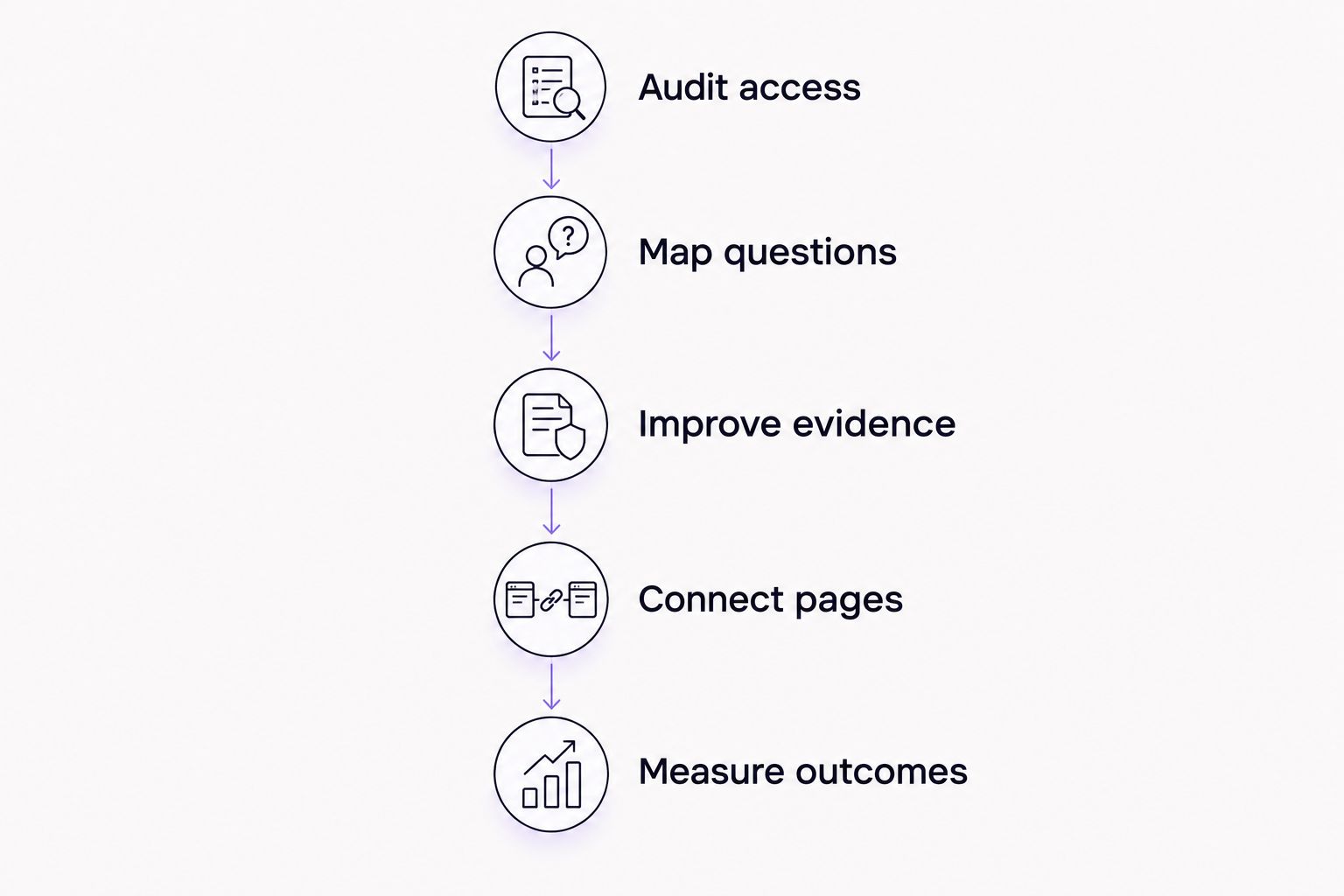
Use one implementation backlog while keeping search and AI-answer outcomes separate.
The workflow fits an internal team or an agency engagement. Visible Monkey is an SEO and GEO agency for businesses seeking Google rankings and AI-assistant citations. Its stated service scope includes content, on-page, off-page, and technical search work; assess that scope against the problems your business needs solved.
If you want outside support, Visible Monkey offers both disciplines. The decision still requires defined deliverables and measurement: an agency's service list is not evidence of a specific result for your website.
Can GEO replace SEO if my website already ranks?
No—existing rankings do not remove the need to maintain indexability, content accuracy, internal links, and conversion paths. Keep successful pages under review while testing where GEO adds a distinct benefit.
Your 2026 plan should protect useful search demand rather than treating it as obsolete. Add citation analysis where it answers a business question that ranking reports cannot.
Should I fix technical SEO before starting GEO?
Yes, when technical faults prevent priority pages from being discovered, indexed, or used. Correct those faults before expecting content changes to solve an access problem.
You can still research buyer questions and inspect generated answers during technical remediation. The work need not stop; the implementation order needs to match the dependency.
How should I measure SEO and GEO together?
Use 2 scorecards: search performance and AI-answer visibility, then connect both to business outcomes where attribution supports the connection. Search reporting covers queries, impressions, clicks, and relevant conversions; answer reporting records mentions, citations, accuracy, and observation conditions.
In 2026 reporting, distinguish a named mention from a clickable citation and both from a qualified inquiry. Do not present them as equivalent wins.
FAQ
Do I still need SEO if I do GEO?
Yes, you still need SEO if you do GEO. Maintain technical access, useful pages, internal links, and conversion measurement while adding analysis of AI mentions and citations.
Is GEO better than SEO for getting customers?
GEO is not a universal replacement for SEO in customer acquisition. Compare qualified inquiries and other relevant conversion outcomes rather than declaring a winner from rankings or citations alone.
Will ranking first on Google guarantee a ChatGPT citation?
No, ranking first on Google does not guarantee a ChatGPT citation. A search position and an assistant's citation are different observations, so measure each directly.
Do I need special schema markup for AI search?
There is no universal schema markup that guarantees AI-search inclusion. Use applicable structured data that matches visible content, and follow the relevant platform's published requirements.
Should I let every AI crawler access my website?
No, crawler access should follow your publishing and data-use policy. Distinguish search retrieval from model training and check each provider's documented crawler controls.
Can one agency handle SEO and GEO?
Yes, one agency can cover both disciplines if its scope includes the required work. Visible Monkey offers SEO and GEO services, including content, on-page, off-page, and technical search services; evaluate ownership and reporting before commissioning work.
One last thing
Write the destination page you would want a cited visitor to land on. It needs a clear answer, credible support, relevant limitations, and an obvious next step—not just a paragraph designed to be extracted.
Before commissioning another batch of content, inspect the pages that explain your core offer. If a buyer cannot tell whether the service fits, fix that first. More exposure sends more people to the same unresolved question.