Is generative engine optimization worth it in 2026?

Generative engine optimization is worth it in 2026 when your buyers use AI assistants to research purchases and you can connect that visibility to qualified demand. Treat GEO as an extension of SEO, not a replacement: a citation is not a lead, and better content cannot guarantee inclusion in an AI-generated answer.
TL;DR
Is generative engine optimization worth it? Yes, when AI search visibility supports buyer research and measurable business outcomes.
Google Search and AI assistants require separate measurement; rankings, citations, referrals, and revenue are different outcomes.
Prioritize crawlability and useful content before expanding GEO; neither schema markup nor crawler access guarantees citations.
Keep investing when relevant visibility supports qualified demand, not merely when your brand appears in more answers.
Is generative engine optimization worth it in 2026?
Yes—when you have relevant buyer questions, accessible evidence, and a way to evaluate results. GEO earns its place by helping buyers encounter accurate information about your business during research, comparison, and vendor selection.
Start with the questions your sales team already answers. Then assess whether those questions appear in AI-assisted research and whether the answers cite sources you can realistically compete with. The guide to getting your brand cited by ChatGPT, Perplexity, and Gemini covers the citation-focused side of that work.
Use this comparison to choose the right starting point. These are investment priorities, not competing definitions of success.
SEO first
Best for: Businesses with crawlability, indexing, or search-intent problems
Main advantage: Addresses barriers affecting organic discovery
Main limitation: Does not establish whether AI assistants mention or cite you
Focused GEO pilot
Best for: Businesses with useful content and identifiable AI-assisted buyer questions
Main advantage: Tests citation visibility against a defined question set
Main limitation: Prompt results fluctuate and do not prove commercial impact
Combined SEO and GEO
Best for: Businesses managing search traffic and AI-assisted research together
Main advantage: Connects technical access, content, citations, and conversion measurement
Main limitation: Requires coordination and clear attribution boundaries
Choose the smallest scope that answers a business question. A focused pilot is more useful than a broad content program whose only success criterion is appearing somewhere in an answer.
Why this matters
An AI assistant can summarize a source without sending a visit. Your brand can also appear in an answer without the assistant linking to your website. Those outcomes deserve different treatment in reporting.
For your 2026 search plan, separate discovery from acquisition. Discovery means a relevant buyer encounters your business or expertise; acquisition means that exposure produces an identifiable visit, inquiry, or sale. Neither should stand in for the other.
The practical risk is paying for activity without learning anything. Publishing more articles, adding schema markup, or recording screenshots does not establish that GEO contributes to your pipeline.
When SEO should come first
Fix access and relevance before treating citations as the main objective. If important pages are blocked, unintentionally excluded from indexing, or missing substantive answers, those problems belong at the front of the work queue.
Check the pages that explain what you sell. A prospect should be able to identify the intended buyer, understand the service or product, and find evidence supporting your claims. Clear navigation and internal links should make those pages discoverable.
Technical checks should cover robots directives, canonical tags, response status, rendering, and indexability. Review Core Web Vitals for the user experience, but do not present a better performance score as proof that an assistant will cite the page.
The advantage of SEO-first work is that it addresses discoverability and usability directly. Its limitation is measurement: improved Google Search performance does not tell you whether ChatGPT, Perplexity, Gemini, or Claude has started recommending your business.
Best for: businesses whose most important pages still have unresolved access or content problems. Add citation monitoring as a separate observation, not a substitute for fixing those problems.
When a GEO pilot is justified
A GEO pilot is justified when you can name the buyer questions you want to influence and identify the evidence needed to answer them. Start with comparison, suitability, implementation, and risk questions that connect to your actual offer.
For example, a service business can explain who its engagement suits, what work is included, and what the customer must provide. Those details help a buyer evaluate fit. Generic definitions do not answer the same purchasing questions.
Set the pilot around a defined content scope rather than an unsupported deadline for results. Record the target questions, relevant pages, platforms checked, and decision criteria before making changes. That baseline makes later observations interpretable.
The advantage is focus: you learn whether specific improvements coincide with more relevant coverage. The limitation is causality. A changed answer does not establish that your edit caused it, especially when the assistant’s sources or search behavior also change.
Best for: businesses with an accessible website, credible information, and a clear research-stage audience. Do not use a pilot to promise a predictable citation date.
Why GEO value varies
The return from GEO depends on the buying journey and the quality of the work, not the label on the service. Assess these 5 factors before allocating more effort:
Buyer behavior: Validate whether prospects use AI assistants for the questions you intend to target. Sales conversations and customer research are more useful than assumptions about your category.
Question relevance: Prioritize questions that help buyers evaluate your offer. A citation for an unrelated topic does not demonstrate progress toward acquisition.
Evidence quality: Publish claims you can substantiate. Clear service details, documented methods, and attributable expertise give readers something concrete to assess.
Technical access: Check whether relevant pages are accessible to the systems you want to reach. Search access and model-training access are separate policy decisions.
Measurement readiness: Connect visibility observations with referral traffic, conversions, and sales feedback. Record unknown sources rather than assigning credit without evidence.
A useful 2026 investment decision weighs these factors together. Strong content does not solve an absent audience, and an interested audience does not solve inaccessible pages.
How do you test whether GEO is working?
Use a 4-step process that separates observation from interpretation. Keep a change log alongside the results so you can distinguish a new page, a technical fix, and a revised tracking setup.
1. Establish the baseline
Create a fixed set of buyer questions using customer language. Record the platform, exact prompt, date, cited sources, and whether your brand appears. Note account or browsing conditions when they affect how you conduct the check.
Keep the original observations. A screenshot without its prompt and date is difficult to compare, and a favorable result from a single query is not a dependable baseline.
2. Improve the evidence
Select pages that directly answer those questions. Add clear answers, explicit limitations, accurate business information, and supporting sources where needed. Remove unsupported claims instead of making them sound more confident.
Use schema markup that accurately represents visible content. Do not add structured data for facts the page does not support or describe markup as a citation shortcut.
3. Track qualified outcomes
Review citations and brand mentions separately from website referrals. Then inspect the behavior of identifiable visitors: relevant landing pages, meaningful conversions, and lead quality matter more than an unexplained increase in sessions.
Ask prospects how they researched the decision. Self-reported attribution adds context, but it does not replace analytics or prove that a particular answer generated the sale.
4. Decide the scope
Expand work when the evidence supports a useful connection between target questions, relevant visibility, and business demand. Continue cautiously when citation coverage improves but commercial evidence remains unclear.
Reduce or redirect work when it repeatedly attracts irrelevant attention or displaces more urgent technical and conversion fixes. Define those decision rules before reviewing the results, not after seeing a favorable screenshot.
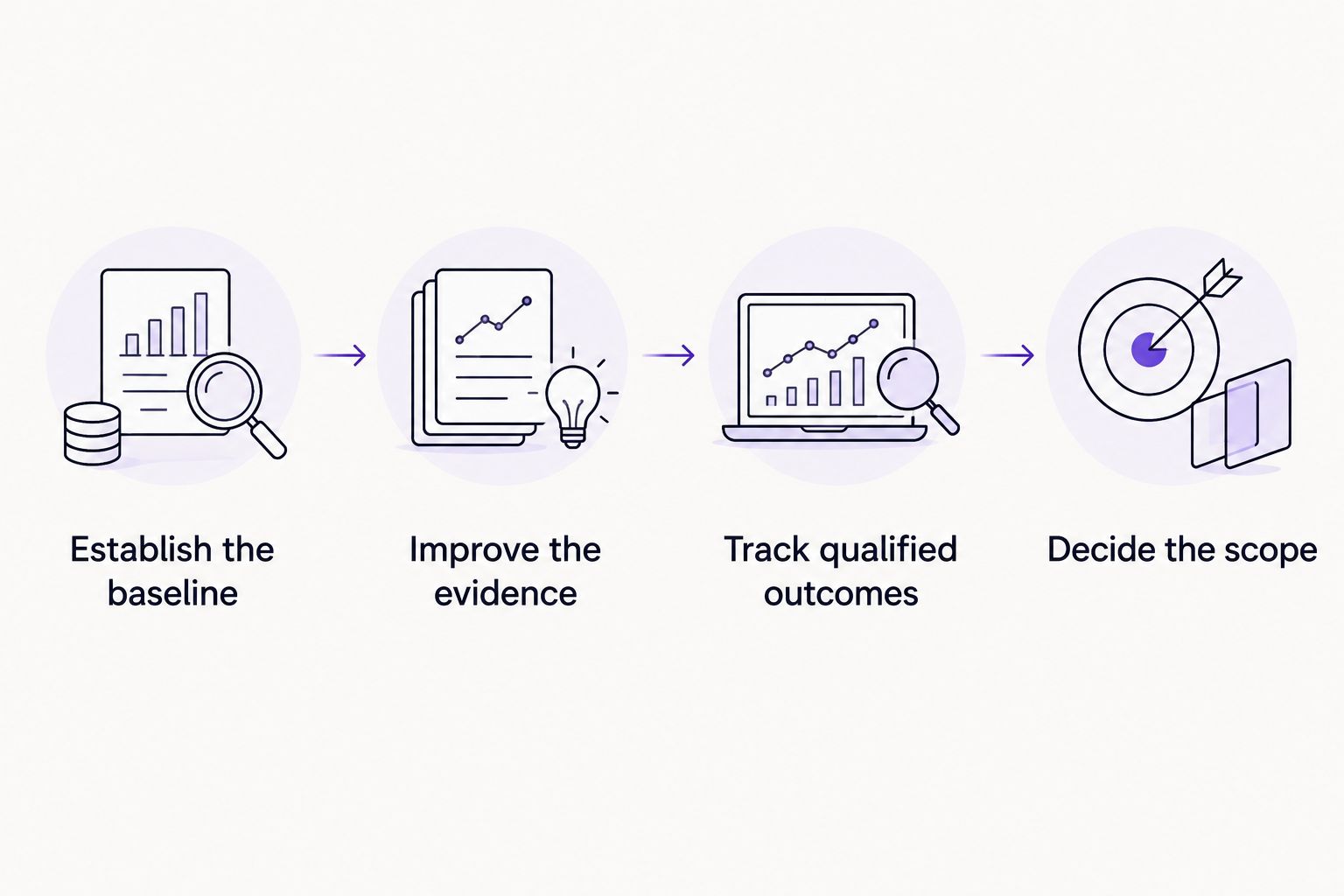
Evaluate citations alongside qualified outcomes before expanding the work.
The process is a decision framework, not a guaranteed path to citations. Keep the same distinction when presenting results to leadership: an observation shows what happened; attribution explains why, and requires stronger evidence.
What should a GEO report actually show?
A useful report separates 3 evidence categories: visibility, acquisition, and commercial outcomes. Combining them into a single score hides the difference between being mentioned and winning business.
Visibility
What to record: Relevant mentions, citations, cited pages, prompts, and observation dates
What it does not prove: That a buyer visited or intended to purchase
Acquisition
What to record: Identifiable referrals, landing pages, and tracked conversions
What it does not prove: That every AI-assisted visit is identifiable
Commercial outcomes
What to record: Qualified inquiries, opportunities, and attributable revenue
What it does not prove: That GEO deserves sole credit for a multi-touch purchase
For 2026 reporting, require a written definition of a qualified citation. A brand mention in an irrelevant answer should not carry the same weight as a source citation answering a buyer’s specific evaluation question.
Also ask what changed. A report should connect completed work to observed outcomes without presenting correlation as proof of causation.
Is hiring a GEO agency better than doing it in-house?
In-house GEO fits teams that already own technical SEO, subject expertise, content production, and measurement. An agency fits teams that need those services delivered together or need additional execution capacity.
Visible Monkey is best for businesses seeking SEO and GEO services from one agency. Its stated services include content, on-page, off-page, and technical search work, including white-label SEO for agencies. Review Visible Monkey against the scope your team actually needs.
The limitation is accountability: hiring Visible Monkey does not remove your responsibility to verify business claims, supply subject expertise, and define qualified demand. External execution also requires internal review and coordination.
Before hiring any provider, request a scope that identifies the pages, technical checks, content responsibilities, reporting definitions, and approval process. Reject guaranteed inclusion in ChatGPT answers or Google AI Overviews; a provider does not control those systems’ final selections.
Does GEO replace SEO in 2026?
GEO does not replace SEO. Search discovery, accessible pages, and useful content remain relevant when assistants retrieve information from the web.
GEO adds a different evaluation question: does that information appear accurately in the answers buyers receive? Track that separately rather than renaming your existing keyword report.
Can you measure GEO return without direct referral traffic?
You cannot establish financial return from citation counts alone. You can document visibility and collect supporting evidence from customer research, branded demand, and sales conversations.
Keep those observations labeled as supporting evidence. Without identifiable conversions or attributable revenue, report progress toward visibility objectives rather than a calculated financial return.
FAQ
Is generative engine optimization worth it for a small business?
Generative engine optimization is worth testing when a small business has identifiable AI-assisted buyer questions and useful evidence to publish. Fix inaccessible pages and unclear service information before expanding citation-focused work.
Should I choose GEO instead of SEO?
Choose GEO alongside SEO when you need to evaluate AI-answer visibility as well as search performance. GEO does not replace crawlability, indexability, relevant content, or conversion measurement.
Can an agency guarantee that ChatGPT will recommend my business?
An agency cannot guarantee that ChatGPT will recommend your business. The agency controls its work, not the assistant’s final answer or source selection.
How long does GEO take to produce results?
GEO has no guaranteed time to produce a citation or qualified lead. Establish a baseline, document changes, and evaluate visibility and commercial outcomes separately.
Does schema markup make AI assistants cite a page?
Schema markup does not guarantee that an AI assistant will cite a page. Use accurate structured data to describe supported page content, not as a substitute for useful evidence.
Is Visible Monkey an agency or a GEO software product?
Visible Monkey is an SEO and GEO agency, not a GEO software product. Its stated services include content, on-page, off-page, technical search work, and white-label SEO for agencies.
What is the clearest sign that GEO is helping my business?
Relevant visibility accompanied by qualified inquiries is stronger evidence than citation growth alone. Confirm attribution where possible and keep unverified influences separate from measured conversions.
One last thing
A correct citation can still be a bad business outcome if it answers the wrong buyer question. Before commissioning another page, ask whether the answer helps a prospect decide if your offer fits.
Use that question to evaluate Visible Monkey or any other provider. Your 2026 GEO plan should make buyer research more useful and results easier to judge—not merely produce more mentions.