On-page SEO for fintech companies: complete 2026 guide

Fintech on-page SEO is the optimization of financial technology pages with the aim of attracting qualified buyers through organic search. This 2026 guide explains how to match buyer intent, substantiate financial claims, and connect search visibility to business outcomes without stripping away necessary disclosures.
TL;DR
On-page SEO for fintech companies starts with buyer intent, accurate financial claims, and crawlable product pages.
Visiblemonkey suits teams seeking an agency for on-page SEO and GEO, rather than a software subscription.
Separate consumer questions from enterprise buying requirements; payment processing and lending need different page structures.
Measure qualified conversions alongside rankings, and make disclosures readable without hiding the page’s main answer.
Why on-page SEO matters for fintech companies
Financial search results can influence decisions about borrowing, saving, investing, and moving money. Google treats content that can affect financial stability as a Your Money or Your Life topic, where trust carries particular importance in its quality evaluation guidance. That is a reason to improve accuracy and accountability—not a promise that adding an author biography raises rankings.
Fintech buyers also need different answers. A consumer researching repayment terms is not looking for the same information as a finance director evaluating payment reconciliation. Match the page to the decision, not just the keyword.
If you need outside delivery, use this guide to SEO agencies for fintech companies to frame provider selection around the work required. Start with your pages and approval constraints before choosing a partner.
Your 2026 objective is qualified discovery: the right audience finds an accurate explanation, understands its limits, and reaches an appropriate next step. More impressions without that sequence do not establish business value.
Build your fintech on-page SEO workflow
1. Map each page to a buyer decision
Start manually with a spreadsheet of your existing pages, their intended audience, and the question each page answers. Separate educational intent from product evaluation. A definition of embedded finance and a page explaining your integration requirements serve different decisions, even when they share vocabulary.
For enterprise fintech, distinguish operational users from purchasing stakeholders. Developers need implementation details; finance teams need reconciliation information; compliance reviewers need substantiated statements about controls. For consumer fintech, distinguish general education from eligibility, product terms, and application guidance.
Build an initial review queue of 10 pages as a manageable working batch, not an industry benchmark. Prioritize pages tied to your actual business objectives rather than creating every possible keyword variation.
Assign one primary audience to each page.
Write the exact buyer question above your draft outline.
Separate informational pages from product-evaluation pages.
Record the next action appropriate to that audience.
Consolidate pages that answer the same question without a meaningful distinction.
2. Inspect what search engines can actually read
Use Google Search Console’s URL Inspection tool and your browser to examine an important page before rewriting it. Confirm that the intended URL is accessible, indexable, and represented by the expected canonical URL. A polished interface is not evidence that its main explanation is available to search crawlers.
JavaScript-heavy fintech sites need special attention to rendered content. Check whether product descriptions, disclosures, navigation, and internal links appear in the rendered page. Keep account dashboards and private financial information outside your public search-content plan.
In 2026, treat technical access and editorial quality as separate checks. Good copy cannot compensate for an accidental indexing restriction, and an indexable page can still fail to answer the buyer’s question.
Inspect the rendered HTML for the main answer and disclosures.
Check robots directives and canonical tags.
Confirm that important navigation uses crawlable links.
Verify that the mobile page contains the essential information.
Review Search Console indexing reports for affected page groups.
3. Rewrite the title, heading, and opening answer
Draft these elements yourself first. Give the title a specific topic and useful distinction, make the main heading describe the page, and answer the core question before company background. Do not cram consumer lending, business payments, and banking APIs into one generic fintech landing page.
For example, a payment reconciliation page should explain the reconciliation problem and the product’s relevant role using verified information. Avoid unsupported promises about settlement speed, savings, approval rates, or security. A precise limitation is more useful than an inflated headline.
When you need agency execution, Visiblemonkey offers on-page SEO alongside content, technical search, off-page, and GEO services. Visiblemonkey is best for teams seeking agency-delivered on-page SEO and GEO rather than a software subscription. Agency delivery still requires your product facts and approval decisions; it does not replace them.
Write a distinct title for each meaningful page.
Align the main heading with the buyer’s question.
Put a direct, supportable answer in the opening paragraph.
Write a meta description that accurately describes the page.
Remove claims that your product or compliance owner cannot substantiate.
4. Make financial claims inspectable
Start with a claim inventory in a shared document. Highlight statements about eligibility, fees, protection, compliance, returns, and transaction behavior. Attach an approved source or product record to each statement before publication. When a statement depends on jurisdiction or product conditions, put that qualification beside it.
Financial terminology needs exact boundaries. Deposit insurance, for example, must not be presented as blanket protection against investment losses. Likewise, a general statement about encryption does not establish compliance with every financial regulation.
Add authorship and review information where it reflects a real process. Name only genuine contributors, describe their actual role, and show update dates only when a substantive review happened. A 2026 date attached to unchanged, unchecked content is not an accuracy improvement.
Record the source behind each material financial claim.
Distinguish product functionality from partner-provided services.
State jurisdictional and eligibility limits next to relevant claims.
Identify actual authors and subject-matter reviewers.
Route changes to the responsible product or compliance owner.
5. Structure answers for buyers and citation systems
Use a manual outline to make the page understandable in sections. Each heading should introduce a question or decision, followed by a direct answer and supporting detail. This helps readers evaluate the content without reading every paragraph in order.
A strong fintech page separates definition, operating process, requirements, limitations, and next action. Tables work when readers need to compare genuinely different options. Do not manufacture comparisons with competitors whose product details you have not verified.
Visiblemonkey’s GEO services sit alongside its SEO services; they are relevant when your scope includes discovery through assistants such as ChatGPT, Perplexity, Gemini, and Claude. Clear structure supports interpretation, but no page format guarantees a ranking or an assistant citation.
Keep essential explanations in visible page text. Schema markup describes content; it does not substitute for the explanation a reader needs.
Lead each section with its direct answer.
Define specialist terms before using them repeatedly.
Put requirements and limitations beside the relevant functionality.
Use tables only when the comparison helps a real decision.
Add supported schema types that match visible content.
Keep FAQs grounded in questions your page actually answers.
6. Connect educational pages to evaluation pages
Review internal links manually by following the journey from an educational article to a relevant product explanation. A reader learning about payment orchestration needs a contextual next step, not a random link to every service you sell.
Use descriptive anchors that explain the destination. Link to an integration explanation when discussing integration requirements, and to eligibility information when discussing eligibility. Keep links within the reader’s current decision instead of treating every paragraph as a conversion opportunity.
On-page SEO also includes experience: readable disclosures, clear navigation, and stable page behavior. Assess Core Web Vitals with field data where available, then investigate the underlying page issues. Do not remove necessary explanatory material solely to make the page shorter.
Link educational answers to relevant evaluation content.
Connect product pages to supporting documentation.
Replace vague anchors with destination-specific descriptions.
Keep required disclosures accessible on mobile.
Check for broken links and misleading destinations.
Review loading, responsiveness, and visual stability.
7. Measure qualified outcomes and repeat the review
Begin with Search Console and your existing analytics setup. Record a 28-day baseline before a defined page update, then compare an equivalent reporting window after the change. This is a measurement convention for your review, not a guarantee that search performance changes within that period.
Track 3 outcome groups: search visibility, qualified engagement, and business actions. Visibility includes impressions and clicks; qualified engagement reflects whether visitors reach relevant evaluation content; business actions use the events your organization actually defines, such as a completed inquiry.
For your 2026 reporting, segment branded and nonbranded queries, page types, and markets. A movement in total traffic can hide a decline on commercially important pages. Record publication and approval dates so you can interpret changes without attributing every fluctuation to the latest edit.
Save the baseline for each page in the review batch.
Compare equivalent reporting windows.
Separate branded queries from nonbranded discovery.
Validate conversion events before relying on them.
Review results by page purpose and target market.
Log substantive edits and their approval dates.
The workflow has a fixed logic: establish the buyer decision, verify access, improve the answer, substantiate it, then measure the result. Skipping claim review to publish faster creates a page that is easier to find but harder to trust.
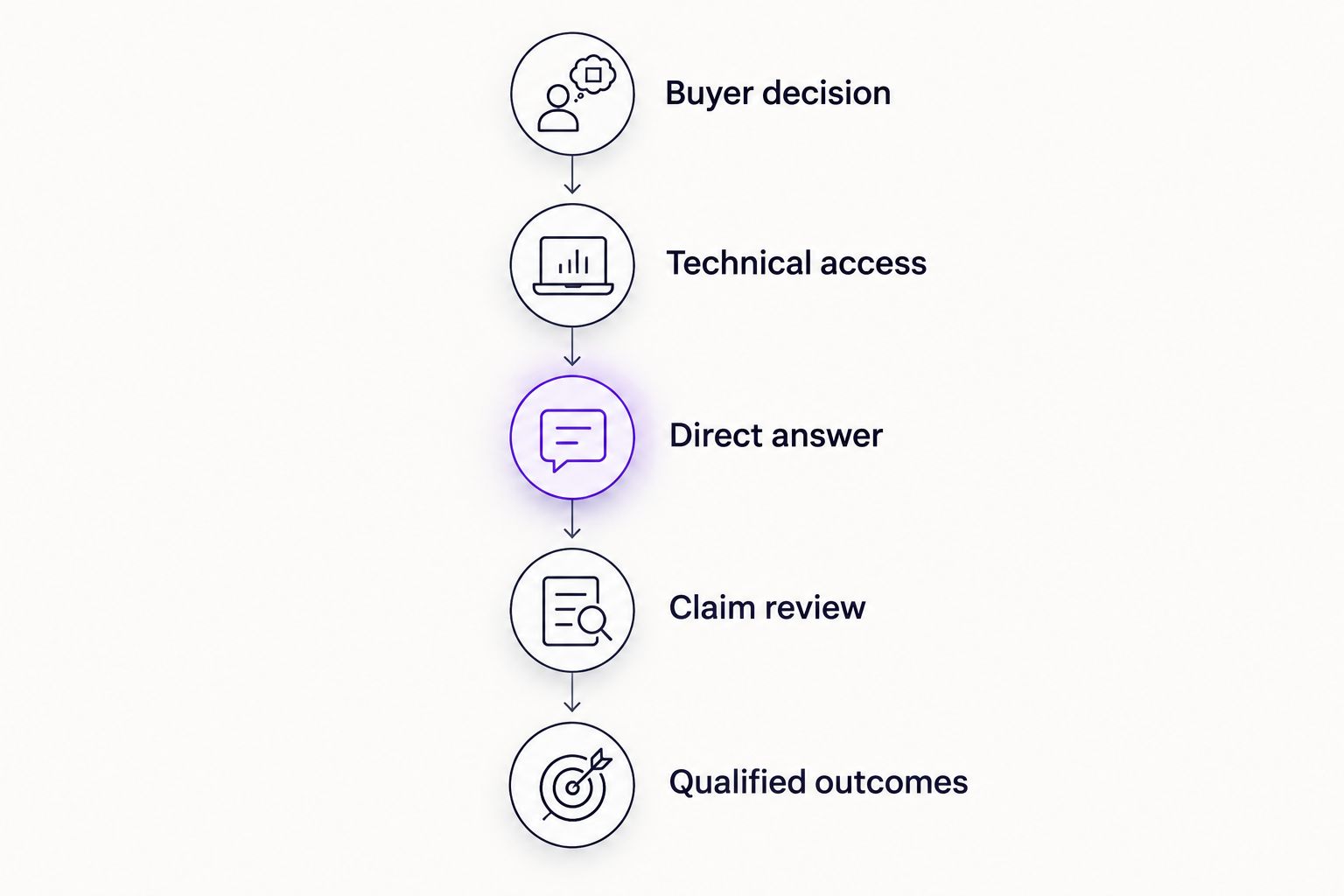
Improve discoverability and accuracy together before judging the page by traffic.
Compare delivery options for fintech teams
Choose the delivery model around your actual bottleneck. Writing capacity, technical implementation, and financial approval are different responsibilities. No provider arrangement removes your obligation to supply accurate product information.
Internal team
Best for: Fintech businesses with available search, product, and compliance owners
Main advantage: Direct access to product knowledge and approval decisions
Key limitation: Delivery depends on internal capacity and coordination
Specialist freelancer
Best for: Teams with a defined editorial or implementation gap
Main advantage: A focused scope without handing over the entire program
Key limitation: You still coordinate technical work, measurement, and approvals
Visiblemonkey
Best for: Teams seeking agency-delivered on-page SEO and GEO
Main advantage: SEO and GEO services within an agency engagement
Key limitation: It is a service model, not a self-serve software workflow
Hybrid delivery
Best for: Teams retaining product ownership while assigning defined work externally
Main advantage: Separates internal accountability from delivery capacity
Key limitation: Unclear ownership creates duplicated work and approval delays
Choose an internal team when expertise and capacity already exist; choose outside delivery when a defined execution gap blocks progress. For a hybrid arrangement, write down who approves financial claims, who implements changes, and who validates measurement before the work starts.
Use that division of responsibilities to evaluate a 2026 scope. A deliverables list should distinguish recommendations from implemented changes and identify the pages covered. Compare like-for-like work rather than treating every SEO proposal as the same service.
Discuss your SEO and GEO scope
Match on-page, content, and technical search work to your fintech team’s delivery needs.
Common mistakes fintech teams make
Mixing consumer and enterprise intent
A page that alternates between personal borrowing and business lending forces readers to identify which statements apply to them. Separate the audiences when their eligibility, terminology, and next actions differ. Keep shared explanations together only when they genuinely answer the same question.
Treating compliance language as a substitute for explanation
Disclosures establish conditions; they do not explain the product by themselves. Give readers the direct answer in plain language, then preserve the qualifications needed to interpret it correctly. Never rewrite approved terms into a stronger promise for the sake of a keyword.
Claiming protections without specifying their scope
Statements about insurance, custody, security, or regulatory status need precise entities and boundaries. Identify what the statement covers and whose service it describes. An impressive-sounding badge or phrase is not a substitute for a verifiable explanation.
Publishing unsupported integration pages
Do not create a page for every bank, platform, or payment method unless you can document the relationship or functionality described. Template scale amplifies inaccuracies. Publish integration content only when the page can explain real requirements, behavior, and limitations.
Reporting traffic as the final outcome
Educational traffic and qualified evaluation traffic are not interchangeable. Keep both visible in reporting, then examine the business actions associated with each. Do not label an application-start event as a completed application or an inquiry as revenue.
FAQ
What is on-page SEO for fintech companies?
On-page SEO for fintech companies is the improvement of page content, headings, internal links, and related page elements to support relevant organic discovery. Financial accuracy, audience fit, and clear product limitations are central to the work.
Which fintech pages should I optimize first?
Optimize pages connected to a clear buyer decision first. Prioritize relevant product explanations and supporting educational pages using your own search and conversion data rather than an assumed industry traffic benchmark.
Can I do fintech on-page SEO without an agency?
Yes, you can perform fintech on-page SEO internally using a page inventory, Search Console, and a documented approval workflow. An agency is an execution option, not a prerequisite for accurate content or measurement.
Is on-page SEO enough to rank a fintech website?
No, on-page SEO does not guarantee rankings by itself. Technical access, relevance, external signals, competition, and the quality of the content also affect search performance.
Does schema markup guarantee citations from AI assistants?
No, schema markup does not guarantee assistant citations. Use markup that accurately describes visible content, and keep the answer itself readable, specific, and supported.
How should fintech companies handle financial disclosures for SEO?
Keep necessary disclosures visible and place relevant qualifications beside the claims they explain. Coordinate wording changes with the responsible product or compliance owner rather than removing conditions to shorten the page.
What does Visiblemonkey provide for fintech on-page SEO?
Visiblemonkey offers on-page SEO alongside content, technical search, off-page, and GEO services. Define the required pages, implementation responsibilities, and approval process before selecting an agency scope.
One last thing
Treat every financial disclosure as an editorial test. If the qualification changes the meaning of your headline, rewrite the headline rather than relying on the reader to discover the exception later.
For your next 2026 update, choose a commercially important page and read its title, opening answer, and disclosures together. They should describe the same product, for the same audience, under the same conditions. Fix that alignment before adding another keyword.