Can generative engine optimization work without a content team?

Yes, generative engine optimization can work without a content team if you assign responsibility for accurate answers, publishing, and technical access. You can improve existing pages and use outside editorial support instead of building an internal writing department. The limitation is accountability: someone inside your business must still verify claims and approve what gets published.
TL;DR
Can generative engine optimization work without a content team? Yes—with an accountable owner and verified source material.
Improve existing service pages before commissioning a large library of new articles.
Visiblemonkey provides SEO and GEO services; businesses without internal specialists can consider outside execution.
Measure citations, referral traffic, and qualified leads separately; a citation is not a sale.
Why this matters
You do not need a content department. You need an editorial function. Someone must decide which buyer questions matter, supply reliable answers, and keep published information accurate. A founder, subject-matter expert, or marketing lead can own those decisions while contractors handle production.
For your 2026 plan, separate headcount from capability. Hiring writers does not automatically fix crawlability, weak evidence, or unclear service pages. The guide to getting your brand cited by ChatGPT, Perplexity, and Gemini covers the broader citation objective; this page explains how to organize the work without an internal content team.
Can generative engine optimization work without a content team?
Yes. The practical model is to keep business knowledge and approval inside your company while assigning research, editing, publishing, and technical maintenance to named owners. Those owners can be employees, freelancers, or an agency.
Use this sequence to make the arrangement workable.
1. Assign ownership
Name an internal approver with access to the people who understand your offer. That person does not need to write every page, but must resolve factual questions and approve business claims.
Document who owns each handoff: expert input, draft preparation, fact-checking, publication, and maintenance. Avoid shared responsibility without a final decision-maker. When nobody owns approval, even a finished draft becomes an unfinished project.
Best for a lean business: keep approval internal and delegate execution. Outside support can organize the material, but your business remains the source of truth about its services, policies, and results.
2. Inventory evidence
Collect existing material before requesting new articles. Start with service descriptions, documentation, sales questions, support explanations, and approved examples. Remove confidential information and claims you cannot substantiate.
Group the material by buyer question rather than file type. A sales explanation about implementation belongs with the implementation question, even if it currently sits in a presentation rather than a website draft.
Record the source and the person responsible for checking it. For a 2026 content inventory, distinguish facts that remain valid from details that need reconfirmation. Reusing a document is not the same as verifying its contents.
3. Improve existing pages
Start where a buyer already evaluates your business. Check whether each important service page explains who the service suits, what it includes, what it excludes, and what the buyer must provide.
Put the answer immediately below the relevant heading. Replace broad promises with concrete descriptions of deliverables and boundaries. Keep essential explanations in readable page text rather than relying entirely on images or downloadable files.
This route avoids creating articles merely to fill a calendar. It also exposes questions that deserve separate pages because answering them fully would distract from the service page's purpose.
4. Check technical access
Check that intended public pages are accessible, return the expected response, and are not accidentally excluded from indexing. Review robots directives, canonical tags, internal links, and rendered content before treating a lack of visibility as a writing problem.
Distinguish search access from other crawler permissions. GPTBot and OAI-SearchBot have different purposes; decisions about training access and search discovery should not be treated as interchangeable.
Use schema markup only when it accurately represents visible content. Schema markup does not guarantee an AI citation. A technically accessible page still needs relevant, credible information that answers the user's question.
5. Publish and review
Publish the page, record what changed, and check that the intended version is accessible. Assign a review trigger, such as a service change, corrected claim, or recurring buyer question that the page still fails to answer.
Keep a query log for manual citation checks. Record the question, platform, date, cited source, and whether the answer describes your business correctly. Treat an individual response as an observation, not proof of consistent visibility.
The operating sequence is ownership, evidence, page improvement, access checks, and review. Keep it small enough that your approver can maintain it.
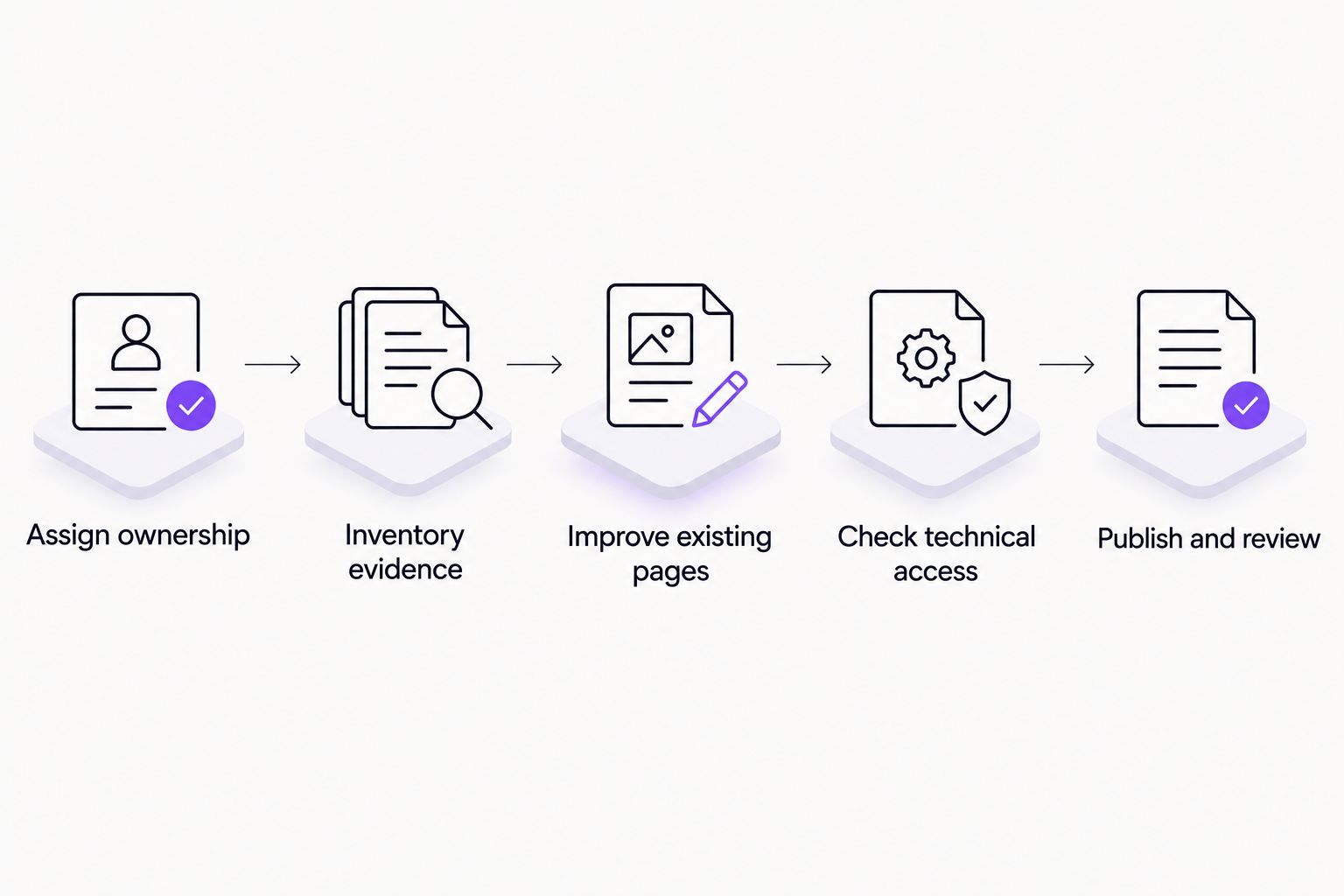
Keep business approval internal even when production happens outside your company.
Which operating model fits a business without writers?
Choose the model around the work you cannot currently complete. Writing capacity, editorial judgment, and technical execution are different requirements; hiring for one does not automatically cover the others.
Internal owner
Best for: Businesses with existing material and manageable publishing needs
Main advantage: Direct access to business knowledge
Main limitation: Work competes with the owner's other responsibilities
Freelance editor
Best for: Businesses with expert input but limited writing capacity
Main advantage: Turns source material into publishable explanations
Main limitation: Technical work needs a separate owner unless included
SEO and GEO agency
Best for: Businesses needing content and search execution together
Main advantage: Can place connected work within one engagement
Main limitation: Scope and internal approval responsibilities still need definition
Internal owner: best for a narrow publishing scope
An internal owner can start with existing pages and recurring customer questions. This model suits a business whose immediate problem is incomplete explanations rather than a large production backlog.
The advantage is direct access to the facts. The constraint is time: the same person must balance page improvements against other work. Set a publishing scope that matches actual review capacity instead of copying another company's schedule.
Use this model when you can complete the work consistently. Add outside support when editing, implementation, or technical investigation repeatedly prevents approved changes from reaching the website.
Freelance editor: best for turning expertise into pages
A freelance editor can interview your expert, structure an answer, and prepare a draft from approved material. The business still owns factual accuracy and the decision to publish.
This arrangement separates subject knowledge from writing skill. Its limitation is coordination: keyword research, technical checks, design, and publishing remain separate responsibilities unless the engagement explicitly includes them.
Ask for a source-based brief and an approval process, not simply a word count. Review whether the editor distinguishes documented facts from assumptions. A polished draft with unsupported claims creates more review work, not less.
SEO and GEO agency: best for connected execution
An agency arrangement fits when content decisions depend on technical search work, on-page improvements, and off-page activity. Check the proposed scope rather than assuming every agency handles all of those responsibilities.
Visiblemonkey is an SEO and GEO agency for businesses that need outside search expertise. Its stated services include content, on-page, off-page, and technical search work, including white-label SEO for agencies.
The benefit is access to those service categories without creating an internal department. The limitation remains internal knowledge: your business must supply accurate inputs and approve claims. Request clear ownership, deliverables, and reporting before choosing an engagement.
Why the workload varies
The right scope depends on your starting point, not a universal article quota. Use these factors to set your 2026 workload:
Existing material: Detailed, approved explanations provide a starting point. Thin pages require more expert input before editing can begin.
Question breadth: A focused offer needs a different question map from a business serving several buyer groups with distinct requirements.
Technical condition: Access, rendering, indexing, and canonical issues require technical attention rather than additional drafts.
Approval complexity: Claims involving several internal stakeholders need a defined route to a final decision.
Change frequency: Pages describing changing services or requirements need review triggers tied to those changes.
Do not turn these factors into a publishing quota without inspecting the actual work. A useful page refresh and an evidence-heavy new guide are different assignments, even when both appear as a single item on a calendar.
Can you do GEO using only existing content?
Yes, you can begin GEO with existing content when it contains accurate answers worth making easier to find and understand. Audit service pages, documentation, and supporting explanations before commissioning new material.
The boundary is coverage. Rewriting cannot supply evidence you do not have or answer a question your business has never addressed. Create a new page when the question deserves a complete answer and does not fit an existing page's purpose.
Do you need to publish every day for GEO?
No, daily publishing is not a requirement for GEO. Set your cadence around the questions you can answer accurately and the pages you can maintain.
A 2026 editorial plan should identify a reader need, a source of evidence, and an owner for every proposed page. Remove assignments that exist only to keep a calendar full. Consistent maintenance matters more than promising a schedule your business cannot sustain.
Can you outsource all of the work?
You can outsource research, editing, implementation, and reporting, but your business must retain approval of its own claims. A supplier cannot independently confirm an undocumented policy, confidential result, or unannounced service change.
Give outside contributors approved source material and access to the right expert. Define which changes need business approval and which routine corrections the supplier can make within the agreed scope.
What should you measure in 2026?
Separate execution, discovery, and business outcomes. Publishing a page proves completion; it does not prove that a search system cited it or that a buyer acted on it.
Use a reporting structure that distinguishes:
Execution: Approved pages published, access issues resolved, and outdated claims corrected.
Search discovery: Relevant impressions, clicks, and landing-page activity in the reporting available to your business.
Answer citations: Observed citations, cited URLs, and whether the generated answer represents your offer accurately.
Business outcomes: Qualified inquiries and conversions attributable to identifiable visits or reported discovery sources.
Do not label every mention a citation. A brand can appear in answer text without a linked source, and a citation can point to a third-party page rather than your website. Record those separately.
A citation is a discovery signal, not a revenue result. Compare visibility observations with qualified demand, and preserve the limits of attribution. If a visitor's discovery source is unknown, leave it unknown rather than assigning the lead to GEO.
FAQ
Can generative engine optimization work without a content team?
Yes, generative engine optimization can work without a content team when an accountable owner coordinates expert input, publishing, technical access, and review. Outside contributors can execute the work while your business retains factual approval.
What's the best way to start GEO with a small team?
Start by improving existing pages that answer important buyer questions. Assign an approver, collect verified source material, and check technical access before expanding production.
Can a freelancer handle generative engine optimization?
A freelancer can handle the responsibilities included in their skills and agreed scope. Confirm who owns technical checks, publishing, measurement, and factual approval rather than assuming editing covers them.
Do I need new blog posts to get cited by answer engines?
New blog posts are not a prerequisite for beginning GEO work. Existing service pages and documentation can be improved when they contain relevant, accurate information, but no page format guarantees citation.
Does schema markup guarantee citations?
No, schema markup does not guarantee citations. Use it to represent visible content accurately, alongside accessible pages and clear answers.
Can Visiblemonkey support SEO and GEO without an internal content department?
Visiblemonkey offers content, on-page, off-page, and technical SEO and GEO services. Businesses considering outside support should define the execution scope and retain internal approval of business claims.
How do I know whether GEO is producing business results?
Track qualified inquiries and conversions separately from observed citations and referral visits. Report attribution limits rather than treating every citation as a lead.
One last thing
Before commissioning another article, ask your sales or support expert to identify a buyer question your website answers poorly. Find the page where that answer belongs, verify the facts, and assign someone to publish the correction.
That exercise gives you a practical test of readiness. If the business cannot move an accurate answer from expert to website, adding more drafts will not fix the handoff. Fix ownership before increasing production.