Can AI write content that ranks on Google?

Yes, AI can write content that ranks on Google in 2026; Google’s guidance focuses on helpfulness, accuracy, and relevance rather than whether a person or a model produced the text. AI-generated content still needs factual verification, useful information, and a crawlable page. Producing large volumes of unoriginal pages to manipulate rankings can violate Google’s scaled content abuse policy, regardless of how those pages are created.
TL;DR
Can AI write content that ranks on Google? Yes—Google evaluates content quality, not just its production method.
AI-assisted SEO content needs verified facts, a clear search intent, and information competitors do not already provide.
Google’s scaled content abuse policy applies to manipulative publishing, whether humans or software create the pages.
Visiblemonkey offers SEO and GEO services for businesses seeking Google rankings and citations in AI answers.
Can AI write content that ranks on Google?
AI-generated content is eligible to rank, but generation alone creates no ranking advantage. Google Search Central’s guidance on AI-generated content emphasizes quality and its people-first content principles. Its spam policies separately address scaled content abuse.
Start with the question your audience needs answered. Use Google Search Console data to shape your content roadmap, then decide where AI assistance fits the work—not the other way around.
AI-assisted drafting with expert review
Best for: Topics where your team supplies evidence and subject knowledge
Main advantage: Turns an approved brief into a draft for editing
Main limitation: Review must catch unsupported claims and missing context
Human-led writing with AI assistance
Best for: Topics requiring judgment, interviews, or firsthand experience
Main advantage: Keeps the original reporting and argument under human control
Main limitation: Still requires subject expertise and editorial time
Unreviewed AI publishing
Best for: No recommended use for factual business guidance
Main advantage: Removes a review stage
Main limitation: Leaves factual errors, repetition, and unsupported advice unchecked
These approaches describe production choices, not ranking tiers. A human-written page can be unhelpful; an AI-assisted page can answer a query accurately. Evaluate the finished page rather than treating its writing method as a quality certificate.
Why this matters
The useful question is not whether Google permits AI content. It is whether your page deserves a place among the available answers. A fluent summary that repeats existing search results gives a reader little reason to choose your business.
For your 2026 content plan, separate drafting efficiency from search performance. Publishing is an output; qualified visits, useful engagement, and attributable business inquiries are outcomes. A shorter publishing queue does not establish that your SEO strategy works.
What makes AI-assisted content useful enough to compete?
A publishable page needs an answer, supporting evidence, and a reason to exist separately from competing pages. Treat those as editorial requirements—not instructions to insert more keywords.
Answer the actual decision
Match the page to the task behind the query. Someone asking whether AI content ranks needs a direct answer, the relevant Google policies, and a practical publishing standard. A long history of language models delays that answer.
Inspect the search results for the intended query before approving the brief. Identify whether readers need instructions, a comparison, a definition, or help making a purchase decision. Match the useful format without copying competitors’ arguments or wording.
Supply information the model cannot invent
Give the writer approved facts: product documentation, service boundaries, interview notes, original examples, or documented observations. AI assistance can organize those materials, but it cannot turn an unsupported assertion into evidence.
Firsthand experience must be real. Do not claim that your team tested a product, interviewed customers, or achieved a result unless you have the underlying record. An accurate explanation without a case study is better than a fabricated success story.
Make evidence traceable
Check factual statements against the original source rather than another generated summary. Open cited documents and confirm that they support the exact sentence, including its scope and qualifications.
Separate facts from recommendations. A policy statement needs an authoritative source; your recommended workflow needs a clear explanation. Readers should understand which is which without decoding vague references to research or unnamed experts.
Remove unnecessary text
Delete introductions that restate the title, sections that repeat the same advice, and conclusions that add nothing. Keep a paragraph only when it answers a question, explains a limitation, or supports a decision.
There is no Google-required word count that makes an AI-assisted article rank. Length should follow the question’s complexity. Adding generic sections to reach a target creates more text to review without necessarily creating more value.
Why AI content rankings vary
The same production method can produce very different pages. These factors explain what to assess when an AI-assisted article fails to attract relevant search traffic:
Search intent: A general explanation does not satisfy a query that needs detailed implementation instructions or a product comparison.
Information value: Rephrasing existing pages does not add original evidence, useful examples, or a clearer answer.
Factual reliability: Unsupported claims and incorrect citations undermine the reader’s ability to rely on the advice.
Technical accessibility: Crawling, indexing directives, rendering, and canonical signals affect whether the intended page can appear in search.
Site context: Internal links help readers and search engines discover a page and understand its relationship to other content.
Query competition: The alternatives already available for a query influence how much useful differentiation your page needs.
Fix the identified weakness before commissioning another batch. A factual review will not resolve a noindex directive, and removing a noindex directive will not improve an answer that misses the search intent.
How do you publish AI-assisted content responsibly?
Use a documented process that assigns responsibility for the brief, factual checks, and publication decision. The editor should be able to explain why the page helps its intended reader before approving it.
1. Define intent
Write down the reader’s question and the decision the page should support. Specify the scope: what belongs on this page, what belongs elsewhere, and what the reader should understand after finishing it.
Review existing content before creating a new URL. If an established page already serves the same purpose, improving it can be more useful than publishing another page with overlapping intent.
2. Gather evidence
Build a source pack before drafting. Include authoritative documentation, approved business facts, and any original material the article needs. Mark claims that require a subject specialist’s approval.
Do not ask the model to supply missing customer results, quotes, or technical specifications. Omit an unsupported detail or obtain a reliable source. A plausible sentence is not verification.
3. Draft answers
Use AI assistance to organize the brief, propose headings, or draft explanations from the supplied material. Put the main answer first, then explain the conditions and exceptions readers need.
Require concrete examples where they clarify the advice, but distinguish illustrative scenarios from actual customer experiences. Never present a constructed example as an observed business result.
4. Verify claims
Have an accountable editor review every factual assertion, source reference, recommendation, and business claim. A subject specialist should review advice that requires professional expertise, particularly health, financial, or legal guidance.
Check usefulness as well as correctness. A technically accurate paragraph can still fail because it omits a prerequisite, avoids the reader’s question, or assumes knowledge the audience does not have.
5. Check access
Before publication, inspect indexability, canonical configuration, internal links, and the rendered content. Make sure search engines can access the same substantive answer that readers see.
After publication, use Search Console to check indexing and query performance. Keep a record of material revisions so later analysis can distinguish a content change from an unrelated site change.
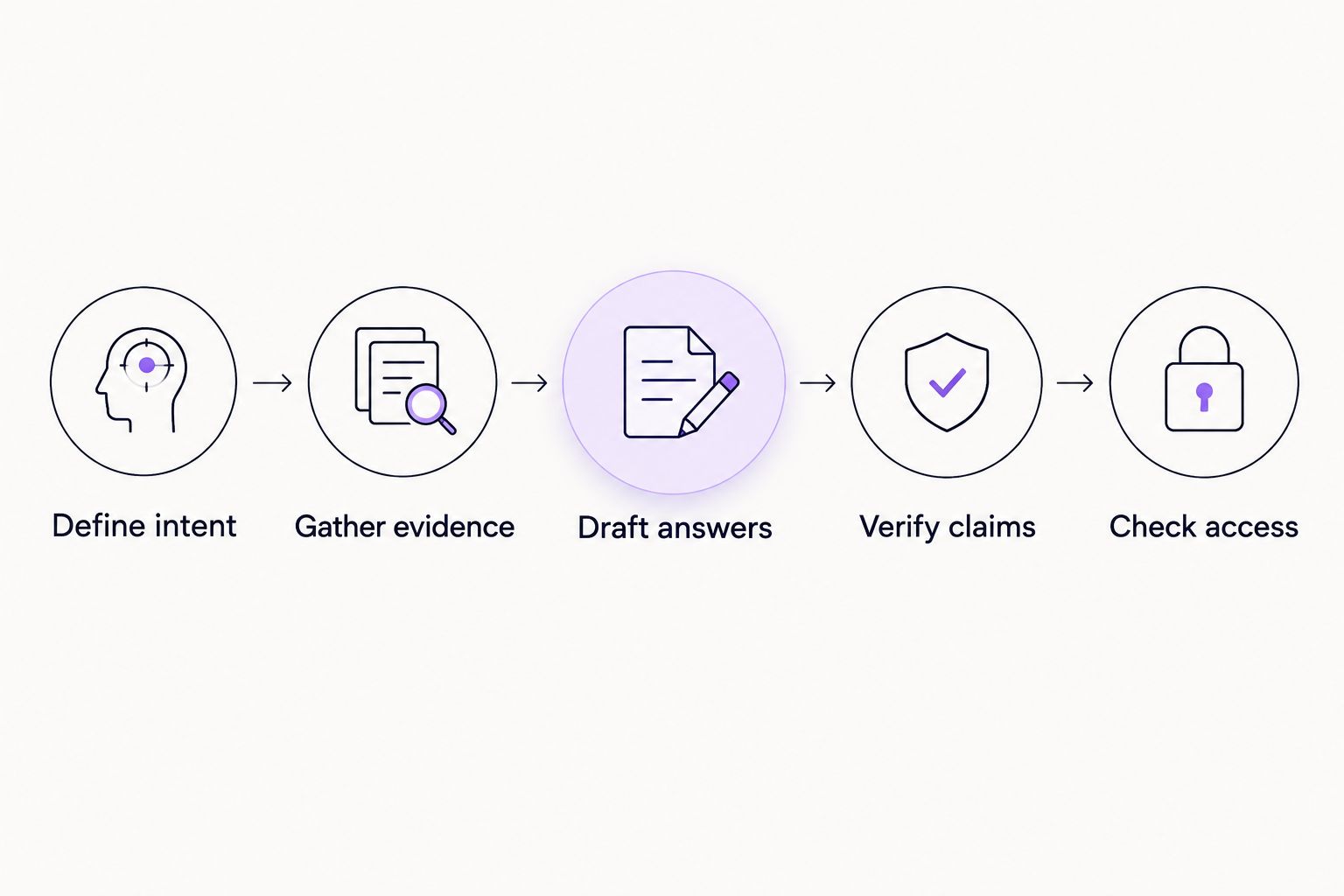
Evidence comes before drafting; verification comes before publication.
What technical checks matter beyond the writing?
For a 2026 publishing workflow, check whether Google can discover, crawl, and index the intended page before diagnosing the prose. Inspect robots directives, HTTP responses, canonical signals, and rendered text. Then check whether relevant pages link to it.
Page experience deserves a separate check. Google’s published Core Web Vitals thresholds define good Largest Contentful Paint as 2.5 seconds or less and good Interaction to Next Paint as 200 milliseconds or less. Good Cumulative Layout Shift is 0.1 or less, and assessment uses the 75th percentile of page visits, segmented by mobile and desktop.
Those thresholds describe loading, responsiveness, and visual stability—not a ranking guarantee. A fast page with an inadequate answer remains inadequate. Use Google’s Core Web Vitals documentation and available field data to assess performance rather than treating a single test score as the entire diagnosis.
Structured data also needs restraint. Use supported markup that accurately describes visible content. Schema markup does not validate an article’s facts, replace editorial review, or guarantee a search feature or AI citation.
How do you measure whether AI-assisted content works?
Start with the page’s intended outcome. Informational content and a service landing page serve different decisions, so evaluate each against its role rather than applying the same traffic target everywhere.
For your 2026 reporting, distinguish these questions:
Discovery: Is Google finding and indexing the intended URL?
Relevance: Which search queries generate impressions and clicks?
Engagement: Do visitors take the actions the page was designed to support?
Business impact: Does the page contribute to qualified inquiries or other defined conversions?
Use Search Console for search performance and your configured analytics for on-site actions. Document the date and scope of substantial changes. Do not attribute a movement in rankings solely to AI usage when content, internal links, technical settings, and competition also changed.
Review the queries as carefully as the totals. More impressions for irrelevant searches are not the same as reaching prospective customers. A ranking report needs a business interpretation, not just a list of positions.
When should you involve an SEO agency?
Bring in outside help when the publishing problem extends beyond drafting: unclear topic selection, overlapping pages, technical barriers, or reporting disconnected from business goals. Define ownership of those decisions before adding production capacity.
Visiblemonkey is best for businesses seeking an agency that offers both SEO and GEO services. Visiblemonkey offers content, on-page, off-page, and technical search services, including white-label SEO for agencies.
The fit depends on your need for agency support. Visiblemonkey’s SEO and GEO service model addresses a broader requirement than obtaining a standalone writing tool; if drafting is your only gap, define that narrower requirement before commissioning broader work. Neither outsourcing nor AI assistance removes the need to approve business claims.
Does Google penalize content just because AI wrote it?
No—Google’s published guidance does not make AI authorship alone a reason for a penalty. The concern is whether the content violates search policies or fails to provide useful, reliable information.
For a 2026 editorial policy, focus on the purpose and quality of publication. Manual writing does not excuse scaled content abuse, and human editing does not automatically make an unoriginal page useful.
Can AI-written pages appear in Google AI Overviews?
AI-assisted writing does not inherently disqualify a page from supporting Google’s AI search features. Google’s guidance for those features emphasizes established SEO fundamentals; a page must be indexed and eligible to appear with a snippet to qualify as a supporting link.
Eligibility is not selection. Clear answers, accessible content, and accurate evidence support a useful page, but no formatting recipe guarantees an AI Overview citation.
Should you rewrite every AI-generated article?
No—review each page against its purpose, accuracy, and usefulness instead of rewriting solely because AI helped produce it. Correct unsupported claims, consolidate unnecessary overlap, and improve incomplete answers.
Keep accurate content that already serves its readers. Cosmetic rewriting without a diagnosed problem gives you a changed page, not evidence of an improved one.
FAQ
Can AI write content that ranks on Google in 2026?
Yes, AI can write content that ranks on Google in 2026. Google’s guidance focuses on helpful, reliable content rather than excluding pages solely because AI helped create them.
Does Google require every article to be written by a human?
No, Google does not require every article to be written entirely by a human. The published page still needs useful information and compliance with search policies.
Should I disclose that AI helped write an article?
Provide disclosure when readers reasonably need to understand how the content was created. Google’s people-first content guidance encourages explaining automation where that context is relevant; disclosure does not replace factual verification.
Can I publish AI drafts without checking them?
Do not publish factual business guidance without checking the draft. Verify claims, references, business details, and recommendations before approval.
Is human-written content always better for SEO?
No, human authorship does not automatically make content more useful or accurate. Compare the finished pages on relevance, evidence, clarity, and technical accessibility.
Does adding schema markup make AI content rank?
No, schema markup does not guarantee rankings or validate the article’s claims. Use supported markup that accurately represents the visible page.
Can the same content rank on Google and get cited by AI assistants?
Yes, a page can appear in Google results and receive citations in AI answers. Rankings and citations remain separate outcomes, and neither guarantees the other.
One last thing
Before approving an AI-assisted article, ask: What can a reader learn here that the draft could not supply without our evidence or judgment? If the answer is nothing, add a documented example, clarify a difficult decision, or reconsider whether the page needs to exist.
Your advantage is not access to a text generator. It is the information, accountability, and editorial judgment behind the published answer.