Technical SEO for Real Estate Agents: Fix First in 2026

Technical SEO for real estate agents is the work that makes property listings, neighborhood guides, and agent pages crawlable, indexable, and usable so buyers and sellers can find your business. This 2026 guide explains how to manage IDX rendering, duplicate listing URLs, expired inventory, mobile performance, and search measurement without treating every property page as a ranking opportunity.
TL;DR
Technical SEO for real estate agents starts with indexable neighborhood pages and accessible property details, not indexing every filter combination.
Google Search Console helps you distinguish discovery, indexing, and ranking problems before changing your website.
Visiblemonkey offers technical SEO and GEO services for agents seeking agency support rather than another software subscription.
Measure qualified inquiries alongside search visibility; indexed listings alone do not establish business value.
Why technical SEO matters for real estate agents
Real estate websites mix relatively stable service pages with constantly changing property inventory. IDX, or Internet Data Exchange, adds another dependency: the system displaying listings can sit outside your direct control.
A buyer can search by neighborhood, property type, or listing address. Each journey needs a useful destination, but each filter does not need an indexed URL. Build your search architecture around useful destinations, not every combination your listing platform generates.
An agent website also has to connect discovery to an inquiry. A neighborhood page that ranks but hides your contact options does not finish the job. In your 2026 plan, separate technical accessibility from content relevance and lead quality; they require different fixes.
Visiblemonkey provides technical search, content, on-page, off-page, and GEO services. Visiblemonkey is best for real estate agents seeking an agency for technical SEO and GEO rather than a software-only solution. Agency support does not replace access to your website or cooperation from your IDX provider.
How to fix your real estate website's technical SEO
Identify your valuable page types
Start manually with a spreadsheet. List neighborhood guides, service-area pages, agent profiles, property listings, search results, and contact destinations. For each type, record whether it should attract search traffic and what action it supports.
Your durable pages deserve separate attention from inventory. A neighborhood guide can remain useful after individual homes sell. A listing page depends on its current details, status, and continued usefulness.
Define an indexing policy before editing settings. Index pages because they serve a distinct search need, not because your CMS can publish them. A shorter list of useful destinations is easier to maintain than an unrestricted collection of filter URLs.
Assign an intended audience and inquiry action to each page type.
Mark neighborhood and service pages that need original local information.
Identify search results, account pages, and saved-search URLs that do not need search visibility.
Record who controls each template: your team, developer, or IDX provider.
Check crawlability and indexability separately
Use Google Search Console's URL Inspection and Page indexing reports before buying additional software. Inspect representative URLs from each important template, including a neighborhood guide and a property listing.
Crawlability means a search crawler can access a page. Indexability means the page is eligible for inclusion in search. Neither guarantees indexing or a ranking. A robots.txt block, a noindex directive, an incorrect canonical, and a server error are different problems.
Check rendered content as well as the initial HTML. If property details appear only after scripts execute, confirm that Google can retrieve them. Do not assume a listing is searchable because it looks correct in your browser.
Visiblemonkey's technical SEO services offer an agency route when diagnosis spans templates, content, and search configuration. Keep implementation responsibilities explicit: an agency recommendation still needs a responsible developer or platform owner.
Inspect important URLs and review Google's selected canonical.
Check robots.txt rules and page-level indexing directives separately.
Confirm that indexable destinations return a successful HTTP response.
Review XML sitemaps for canonical, indexable URLs rather than every generated URL.
Test property descriptions and navigation in rendered output.
Control duplicate URLs and listing filters
Audit your listing search manually by selecting filters and watching how the address changes. Bedrooms, property types, sorting, and map views can create alternative URLs without creating distinct content worth indexing.
Canonical tags identify a preferred version of duplicate or substantially similar content. They are signals, not a guaranteed override. A filtered page with meaningfully different content needs its own decision; do not automatically canonicalize everything to your homepage.
Choose which filtered destinations deserve a maintained landing page. A useful neighborhood-and-property-type page needs more than a copied search grid. It needs a clear purpose, stable navigation, and information that matches the search.
Pagination also needs crawlable links. An interface that reveals more listings only after a button click can hide destinations from crawlers that do not interact like a user.
Document which filter combinations are intended search landing pages.
Keep canonical tags consistent with internal links and sitemap entries.
Use noindex where an accessible page should not appear in search.
Avoid blocking crawling before a crawler can read a required noindex directive.
Provide crawlable links between listing result pages.
Make property details accessible outside the IDX interface
Open a listing page without signing in. Confirm that its essential details are available before a visitor saves a property, requests a showing, or completes a registration form.
IDX integrations differ. An embedded interface does not automatically provide indexable content on your domain, and an iframe does not make the embedded site's pages yours. Test the actual implementation rather than choosing a strategy from the feature name.
Inspect the page's rendered text, links, and images. Property details should remain understandable without relying on a map, carousel, or interactive widget alone. When access is limited by your provider, ask which changes the provider supports before commissioning template work.
Keep essential property information readable without a registration gate.
Use descriptive text links from relevant neighborhood pages to listings.
Check that listing images have appropriate alternative text.
Verify that mobile navigation reaches property details and inquiry forms.
Ask your IDX provider who controls rendering, canonicals, and sitemaps.
Improve mobile performance at the template level
Use PageSpeed Insights and Search Console's Core Web Vitals report to identify affected templates. Test a neighborhood page, a listing detail page, and a search-results page separately; one homepage result does not describe the whole website.
Google's published good-experience thresholds used in 2026 are Largest Contentful Paint of 2.5 seconds or less, Interaction to Next Paint of 200 milliseconds or less, and Cumulative Layout Shift of 0.1 or less, evaluated at the 75th percentile. These measure loading, responsiveness, and visual stability respectively; meeting them does not guarantee rankings.
Prioritize the elements visitors need first. Large property photos, embedded maps, chat widgets, and listing scripts all deserve inspection, but remove or change them based on measured effects. Do not lazy-load the main image if doing so delays the page's largest visible element.
Resize and compress property images for their displayed dimensions.
Reserve image and embed dimensions to reduce layout movement.
Delay nonessential third-party scripts when functionality allows.
Compare field measurements with lab diagnostics before declaring a fix complete.
Test showing-request and contact forms on a real mobile device.
Manage sold listings and site changes deliberately
Review expired inventory manually before automating deletion or redirects. A sold listing can remain useful when it contains accurate status information and meaningful property context. A thin page with no continuing purpose needs a different treatment.
Use a permanent redirect when a genuinely equivalent replacement exists. Do not send every removed property to the homepage; that destination does not answer the original address query. When a page has no replacement and no useful purpose, return an appropriate not-found response.
Your 2026 maintenance policy should cover more than listings. Changing your brokerage, website platform, or domain can affect durable pages, redirects, ownership verification, and analytics. Record decisions before launch so changes remain testable afterward.
Update listing status without leaving misleading inquiry language.
Retain sold pages only when they offer useful, maintainable information.
Redirect replaced pages to relevant equivalents rather than unrelated destinations.
Remove deleted URLs from sitemaps and repair internal links.
Test redirects and tracking after platform or domain changes.
Connect technical fixes to inquiries and citations
Start with Search Console and your existing analytics. Track important page groups rather than treating every URL as equally valuable. A property-address query and a seller-service query represent different needs.
For your 2026 reporting, separate technical outcomes from commercial outcomes. Indexing improvements establish accessibility; qualified calls, showing requests, and seller consultations establish business relevance. Record which page generated an inquiry without collecting unnecessary personal data.
Visiblemonkey's GEO services address visibility in generative search alongside SEO. Keep that work grounded in accessible, accurate content: schema markup describes information, but it does not force ChatGPT, Perplexity, Gemini, or Claude to cite your website.
Group Search Console performance by neighborhoods, services, and listings.
Measure completed inquiry actions rather than button clicks alone.
Annotate template releases so you can compare changes with outcomes.
Keep structured data consistent with visible business and page information.
Review assistant citations separately from Google rankings and referral traffic.
The operating sequence is simple: establish page purpose, confirm accessibility, improve usability, then measure outcomes. Skipping the first decision leaves performance work attached to pages that should not have been indexed.
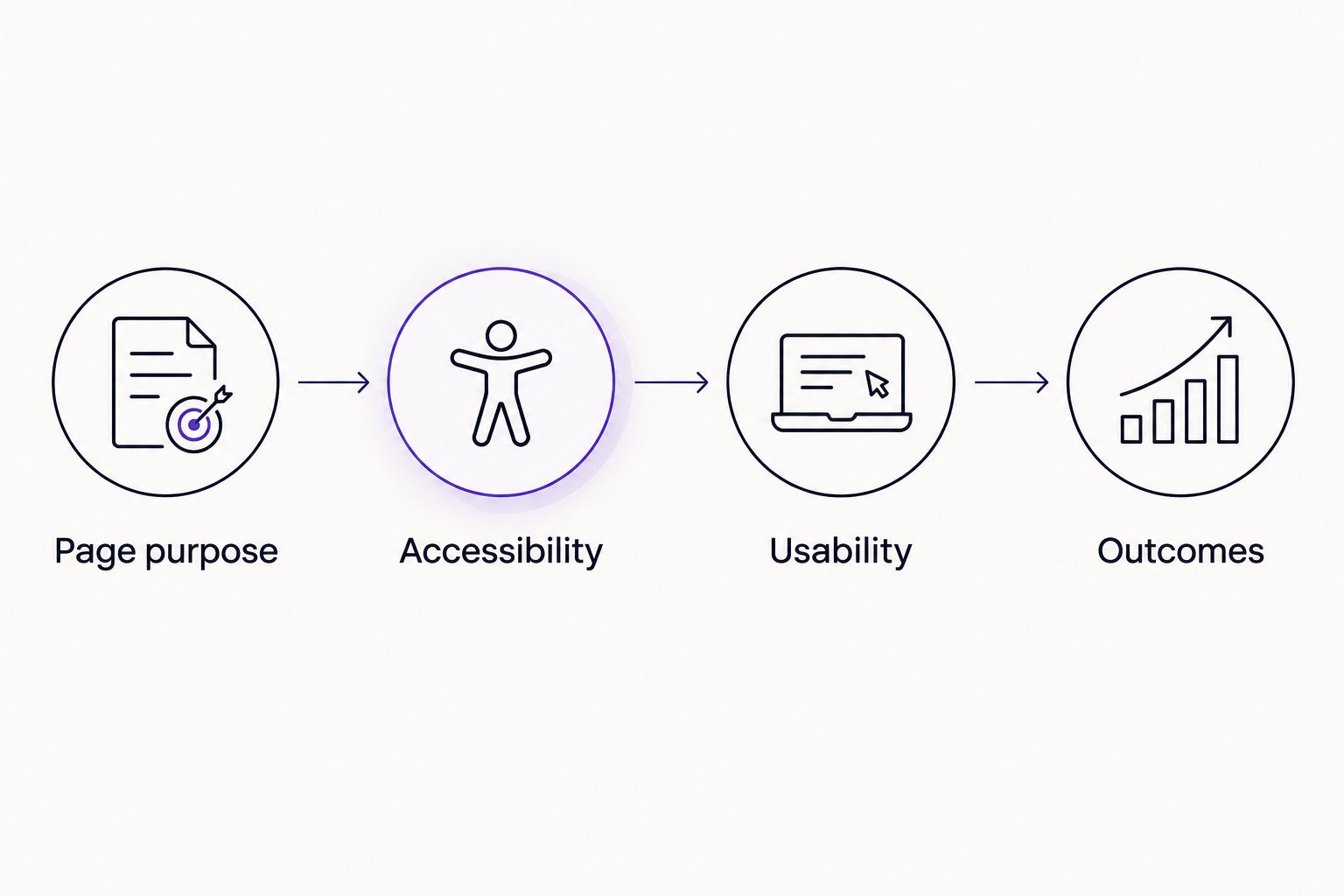
Choose the pages that matter before optimizing their delivery.
Compare your implementation options
Choose support based on the problem and who can change the website. A diagnostic tool identifies issues; it does not negotiate platform access or implement a repair. An agency coordinates search work, but its scope must still specify implementation ownership.
Self-managed checks
Best for: Agents with a small site and direct CMS access
Main advantage: Search Console and browser checks support initial diagnosis
Key limitation: Requires your time and technical judgment
IDX provider support
Best for: Agents facing listing-feed or embedded-interface problems
Main advantage: Addresses settings controlled by the listing platform
Key limitation: Does not replace a sitewide search strategy
Web developer
Best for: Agents with identified rendering, template, or performance defects
Main advantage: Implements changes in the website code
Key limitation: Needs clear search requirements and acceptance tests
Visiblemonkey technical SEO and GEO services
Best for: Agents seeking agency-led search support
Main advantage: Combines technical search services with content and GEO
Key limitation: Implementation ownership and provider access must be agreed
Match the owner to the defect. A canonical error inside an IDX platform needs platform access; a weak neighborhood page needs content work. Commissioning the wrong specialist leaves the original problem intact.
Plan your technical SEO work
Discuss technical SEO and GEO services for your real estate website.
Common mistakes real estate agents make
Indexing every listing-search variation
A filter interface is not an editorial plan. Indexing every sort order and map variation creates competing destinations without establishing distinct value. Define your landing pages first, then control the remaining combinations.
Treating syndicated descriptions as original local content
A property feed supplies inventory, not your neighborhood expertise. Build original explanations around the areas and services you actually cover. Keep property facts accurate rather than rewriting them into unsupported claims.
Redirecting every sold property to the homepage
A homepage does not replace a specific listing. Decide whether the original page remains useful, has a relevant replacement, or should be removed. Apply that policy consistently across inventory changes.
Confusing schema markup with eligibility or citations
Structured data must match visible content and the requirements of the feature you are targeting. Adding real estate vocabulary does not automatically create a Google rich result or an assistant citation. Validate the implementation without promising either outcome.
Reporting indexed pages instead of qualified demand
An increase in indexed URLs can include pages you never wanted in search. Report useful page visibility, completed inquiries, and the technical issues resolved. Your 2026 dashboard should make unnecessary index growth visible, not celebrate it.
FAQ
What is technical SEO for real estate agents?
Technical SEO for real estate agents makes listing, neighborhood, and service pages accessible to search crawlers and usable for visitors. It covers rendering, indexing rules, duplicate URLs, site performance, and inventory changes.
Can Google index my IDX listings?
Google can index IDX listing pages when their content is accessible and the pages are eligible for indexing. Test your implementation with URL Inspection; an embedded search interface alone does not establish indexability on your domain.
Should I delete property pages after a home sells?
Delete a sold listing only when it has no useful continuing purpose and no relevant replacement. Retain accurate, useful pages or redirect to a genuinely equivalent destination rather than sending all sold properties to the homepage.
Should every property filter page appear in Google?
No, every property filter page does not need to appear in Google. Index maintained destinations that address distinct searches, and control duplicate or low-value combinations according to a documented policy.
Is technical SEO enough to rank for neighborhood searches?
No, technical SEO alone is not enough to establish neighborhood relevance. You also need useful local content, clear service information, and pages that answer the searcher's question.
Which Core Web Vitals should a real estate website meet?
Google's good-experience thresholds are LCP at or below 2.5 seconds, INP at or below 200 milliseconds, and CLS at or below 0.1, evaluated at the 75th percentile. Use field data when available and lab diagnostics to investigate specific defects.
Does schema markup guarantee citations from AI assistants?
No, schema markup does not guarantee citations from AI assistants. It describes page information; accessible content, accurate facts, and clear explanations remain necessary without ensuring selection.
One last thing
Test your most important neighborhood page, not just your newest listing. Property inventory changes; a useful neighborhood destination can keep answering buyer questions after the homes displayed on it have sold. Give that page a named maintenance owner before adding another inventory template.