GEO vs SEO: How to Optimize for AI Search 2026

Why Generative Engine Optimization (GEO) Is the Future—But Traditional SEO Still Matters
What You'll Take Away From This:
AI search (ChatGPT, Google AI Overviews, Perplexity) is already the dominant way people find information — and it's only growing
GEO isn't a replacement for SEO — it's the next layer. You need strong SEO fundamentals before GEO can work
To get cited by AI, your content must directly answer questions, be well-structured, data-backed, and authoritative
Businesses that adapt to AI-powered search now will dominate. Those that don't will become invisible
If you're invested in SEO, you've probably noticed something: search is changing. Fast. Welcome to the era of Generative Engine Optimization (GEO), also known as Answer Engine Optimization (AEO). This isn't another buzzword to ignore—it's a fundamental shift in how people find information online.
Every time someone uses ChatGPT to research a topic, asks Google's AI Overview for recommendations, or queries Perplexity for comprehensive answers, they're bypassing traditional search results. And here's what keeps marketers up at night: if your content isn't optimized for these AI-powered search engines, you're becoming invisible to a rapidly growing segment of searchers.
But before you panic and throw your entire SEO strategy out the window, understand this: GEO doesn't replace SEO—it builds on it. Think of traditional SEO as your foundation and GEO as the next floor up. You can't skip the foundation, but you also can't afford to stop building.
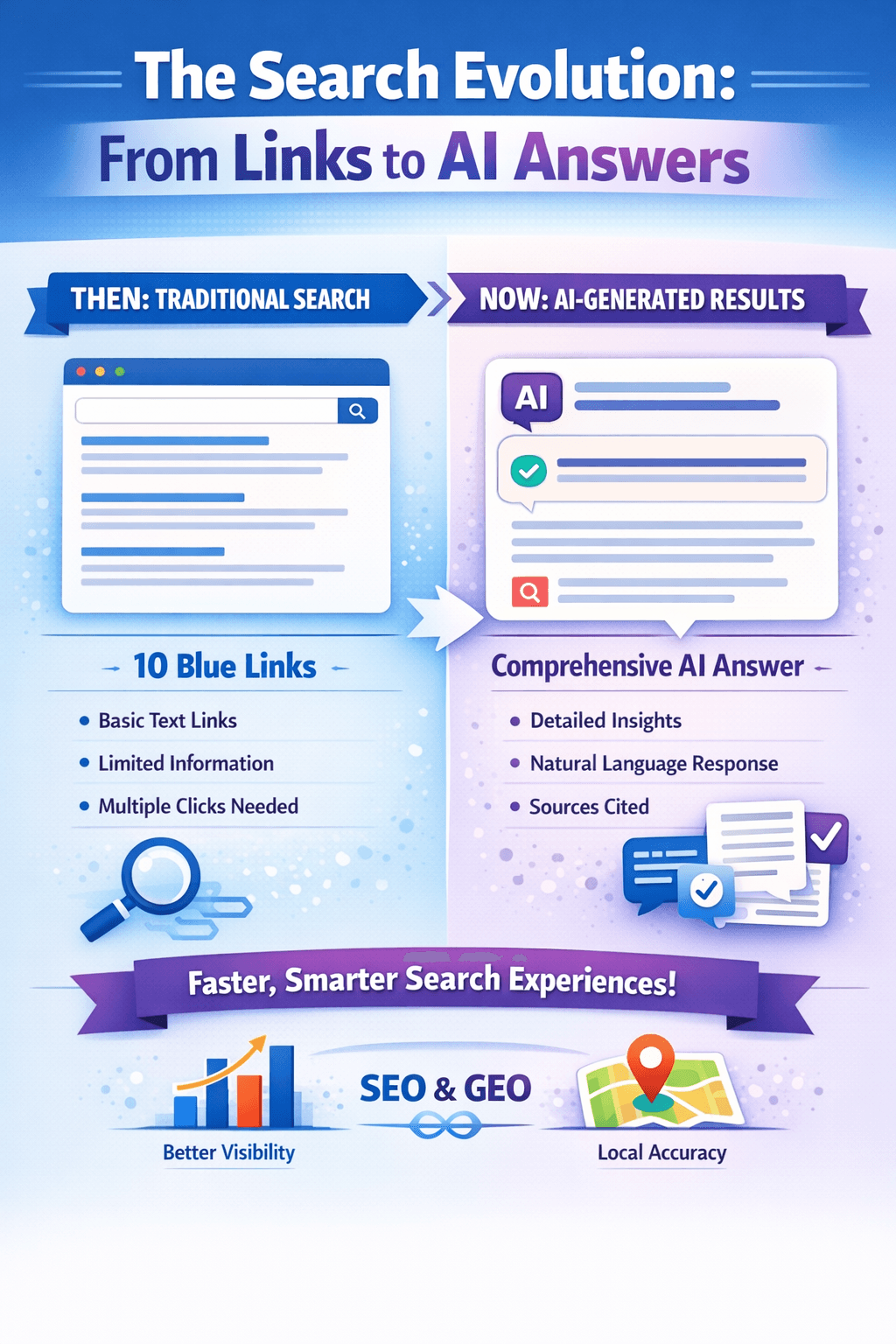
Traditional SEO: The Foundation AI Search Depends On
Let's address the elephant in the room: Is SEO dead? Absolutely not. In fact, traditional SEO is more critical than ever because it's the infrastructure that enables GEO to work.
AI-powered search engines like ChatGPT, Google Gemini, Perplexity, and Bing AI don't conjure answers from the ether. They crawl, index, and analyze web content—your web content—to generate their responses. If your SEO fundamentals are broken, AI engines can't find you, can't understand you, and definitely won't cite you.
The 4 SEO Pillars That Enable GEO Success
1. Technical SEO and Crawlability – Before AI can cite your content, it needs to find it. Broken site architecture, slow load times, poor mobile optimization, or restrictive robots.txt files make you invisible to both traditional and AI-powered search. The technical basics—XML sitemaps, clean URL structures, HTTPS security, proper redirects—are non-negotiable prerequisites for any search visibility strategy.
2. Content Quality and E-E-A-T – AI models are trained to recognize expertise, authoritativeness, and trustworthiness. Google's E-E-A-T framework (Experience, Expertise, Authoritativeness, Trustworthiness) matters exponentially more in the age of generative search because AI uses these signals to determine which sources deserve citation. Thin, generic, or poorly researched content gets filtered out before AI ever considers featuring it.
3. Structured Data and Schema Markup – When you implement schema markup, you're essentially providing AI with a content roadmap: 'This section is a product review. This is the rating. This is pricing information. This is an author bio.' Without semantic structure, AI engines have to guess at your content's meaning—and they often guess wrong or skip you entirely.
4. Backlink Authority and Trust Signals – AI doesn't evaluate your content in isolation. It assesses how the broader web perceives you. High-quality backlinks from reputable domains signal to AI models that your content is citation-worthy. Think of backlinks as digital endorsements—and AI takes those endorsements seriously when deciding which sources to reference.
💡 KEY INSIGHT: You cannot build successful GEO strategies on a weak SEO foundation. If AI can't crawl your site, doesn't trust your content, or can't understand your structure, no amount of 'AI optimization' will help.
What Is GEO (Generative Engine Optimization)?
Generative Engine Optimization (GEO) is the practice of optimizing your content so AI-powered search engines cite, reference, and feature your information in their generated responses. Instead of ranking in position #3 for a keyword, GEO success means being the source ChatGPT quotes or the article Google's AI Overview cites when answering a user's question.
Think about your own behavior: when you ask ChatGPT for advice or use Google's AI Overview, you rarely click through to the original sources. You get your answer right there. This is zero-click search—and it's becoming the dominant form of information discovery. If your content isn't optimized for AI-generated answers, you're missing the fastest-growing segment of search traffic.
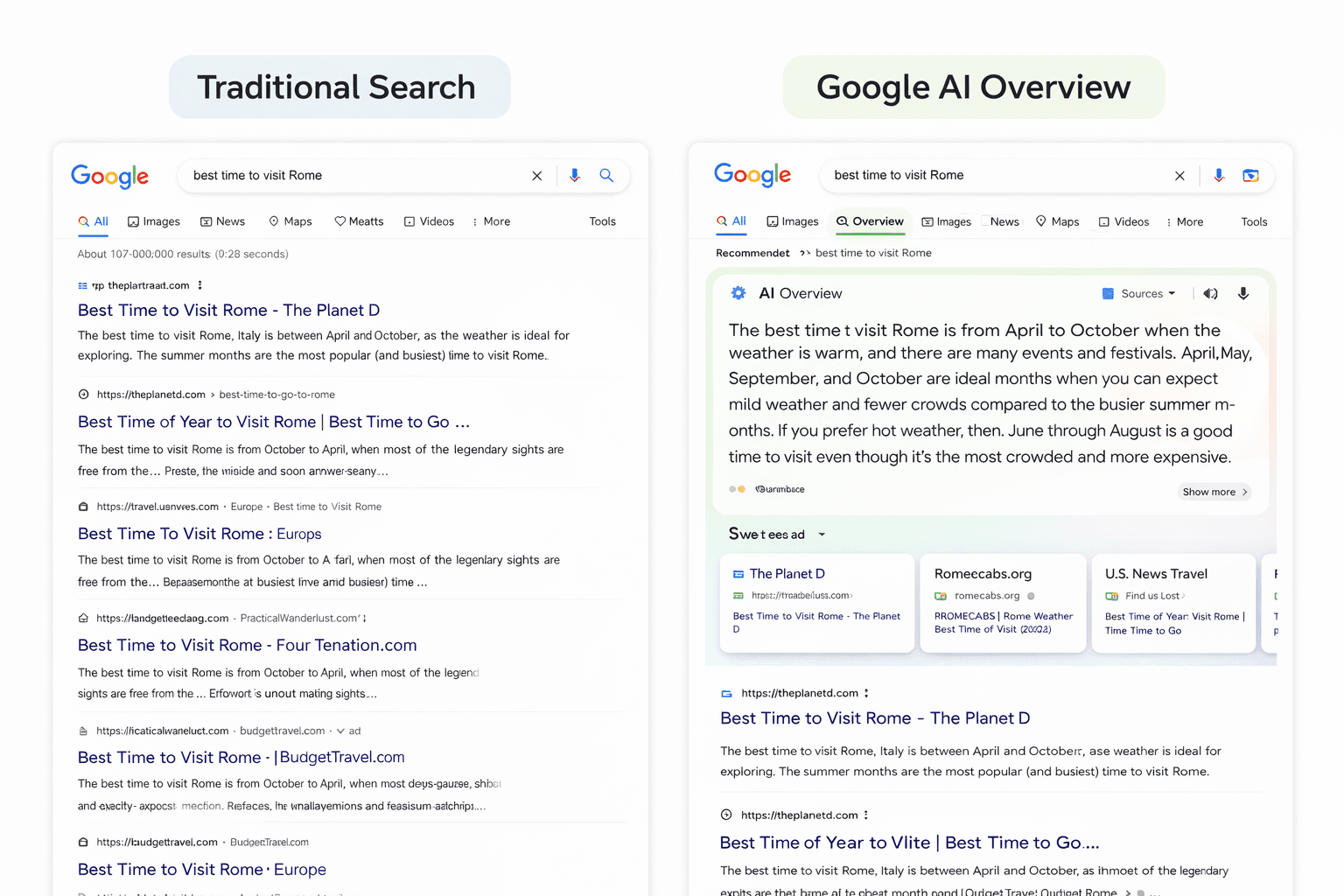
How GEO Builds on Traditional SEO Principles
Here's what makes GEO different from—but complementary to—traditional SEO:
Direct, Comprehensive Answers Over Keyword Targeting – Traditional SEO optimization often focuses on strategic keyword placement and density. GEO requires you to actually answer the question thoroughly and accurately. If someone searches for 'best project management tools for remote teams,' GEO-optimized content provides a clear, structured answer with specific recommendations, feature comparisons, and pricing context—not just mentions of 'project management tools' sprinkled throughout generic paragraphs.
Structured, Scannable Formatting – AI loves hierarchy and clarity. Use descriptive headings (H2s, H3s) that directly answer questions. Format information with bullet points, numbered lists, comparison tables, and concise paragraphs. Think of your content as API documentation—it needs to be easily parseable by machines while remaining valuable for humans.
Data-Backed, Cited Information – AI models prioritize content that cites credible sources, includes verifiable statistics, and links to primary research. If you make a claim, back it up with data. This builds trust with both AI algorithms and the humans who might fact-check AI-generated responses.
Natural Language and Conversational Queries – People interact with AI differently than traditional search. Instead of typing 'CRM software small business,' they ask, 'What CRM should I use for my 10-person marketing agency?' Answer Engine Optimization means creating content that addresses these longer, more conversational, question-based queries naturally.
Topic Clusters Over Individual Keywords – AI understands topics and relationships between concepts holistically. Rather than creating isolated blog posts targeting individual keywords, GEO rewards comprehensive topic coverage. Build content hubs: if your topic is email marketing, create interconnected resources covering deliverability, subject lines, segmentation, automation, compliance, and analytics. AI rewards topical authority.
SEO vs GEO: Key Differences at a Glance
Aspect | Traditional SEO | GEO (Generative Engine Optimization) |
Primary Goal | Rank in search results for target keywords | Be cited by AI in generated responses |
Content Focus | Keyword optimization and link-worthy content | Direct answers to conversational queries |
Success Metric | Ranking position and click-through rate | Citation frequency in AI responses |
User Behavior | Users click links to visit websites | Users get answers without clicking (zero-click search) |
Content Structure | Optimized for search crawlers | Optimized for AI parsing and synthesis |
Why You Cannot Ignore Generative Engine Optimization in 2026
The data is undeniable: AI-powered search is exploding. Google's AI Overviews appear in over 60% of searches in some verticals. ChatGPT has hundreds of millions of active users. Perplexity, Claude, Microsoft Copilot, and other AI search tools are growing exponentially. These aren't experimental features—they're becoming the primary way people find information.
If your content isn't optimized for AI-generated answers, you're invisible in an increasingly large—and valuable—portion of search interactions. Even if you rank #1 in traditional Google search results, you might not appear in the AI Overview that shows up above those results.
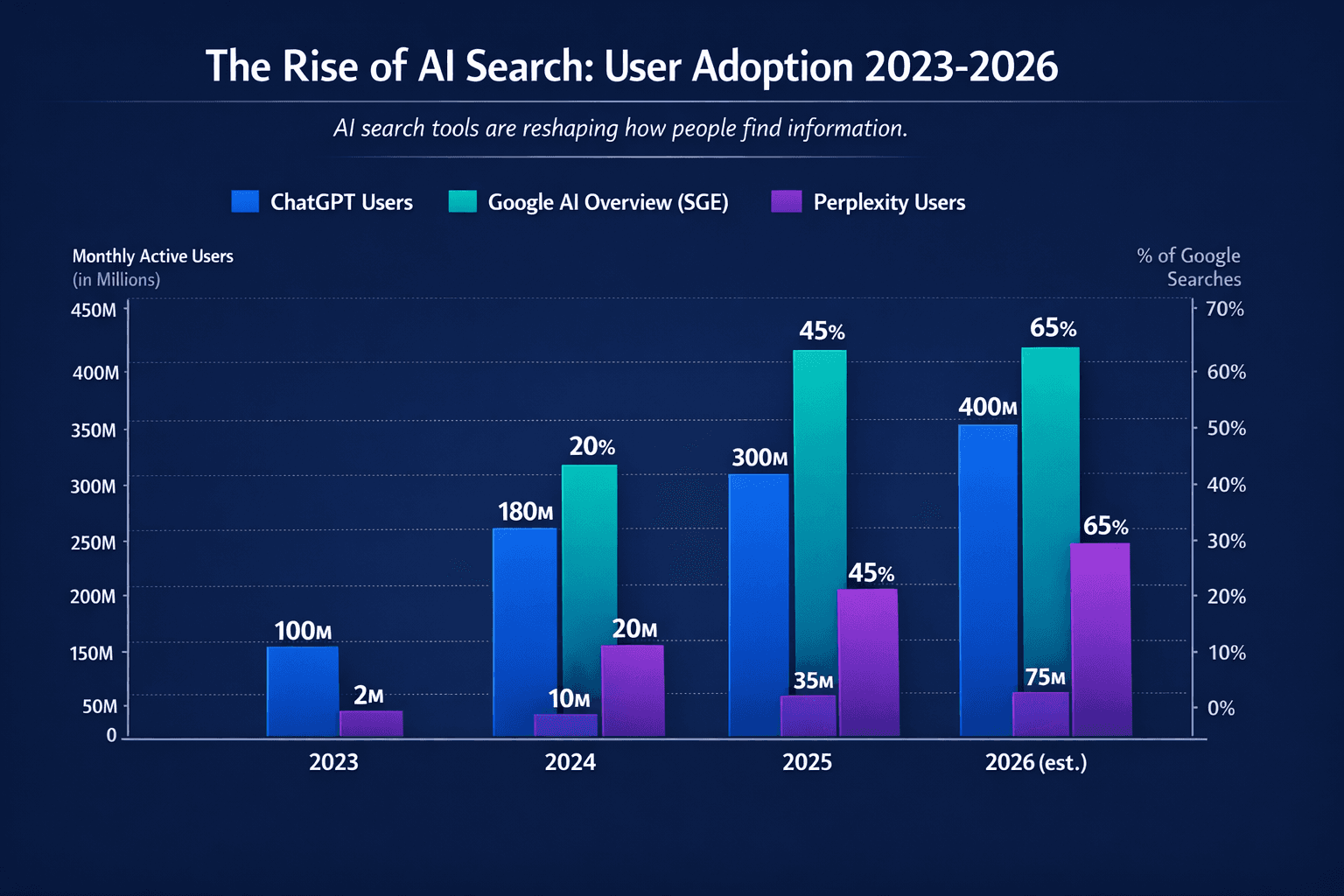
The Zero-Click Search Reality (And Why It's Not All Bad)
AI-generated answers create what's known as zero-click searches—users get their information without clicking through to any website. If your business model depends on website traffic, this sounds terrifying.
But consider the upside: when ChatGPT says 'According to Visible Monkey's comprehensive guide on SEO strategies...' or Google's AI Overview cites your research, that's an endorsement more powerful than any traditional ranking. You're positioned as the trusted expert in your field.
Moreover, many AI-generated responses include citations and links. Users who click those citations are highly qualified—they've already been pre-vetted by AI as interested in your specific expertise. Click-through rates might be lower, but conversion rates are often substantially higher.
How to Optimize for AI Search: Combining SEO and GEO
The winning strategy in 2026 isn't choosing between SEO and GEO—it's implementing both in tandem. Build a rock-solid SEO foundation, then layer strategic GEO tactics on top to maximize AI visibility.
The SEO Foundation Layer
Technical excellence: Fast page load times, mobile optimization, clean code, proper indexing, secure HTTPS
Authoritative backlinks: Build credibility through guest posting, digital PR, industry partnerships, and creating genuinely link-worthy content
Domain authority: Consistent publishing schedule, domain age, brand mentions, trust signals
User experience optimization: Intuitive navigation, low bounce rates, high dwell time, mobile-first design
The GEO Optimization Layer
Answer-focused content: Write articles that directly answer common questions in your industry. Use question-based headings.
Structured formatting: Use clear H2/H3 hierarchies, bullet points, numbered lists, comparison tables, and scannable layouts that AI can easily parse
Data-backed claims: Include statistics, cite credible sources, link to primary research. Make your content verifiable.
Comprehensive topic coverage: Build content hubs that cover topics thoroughly. AI rewards topical authority over keyword stuffing.
Natural language optimization: Write conversationally. Answer questions as if talking to a real person, not gaming an algorithm.
Enhanced schema markup: Use structured data (schema.org) to help AI understand your content type, author credentials, publication date, and key facts
Real-World Example: Old vs. New Approach
❌ Old SEO-Only Approach: A 600-word blog post titled 'CRM Software' with the keyword 'CRM' mentioned 35 times, thin content, and no real value.
✅ SEO + GEO Approach: A 2,500-word comprehensive guide titled 'How to Choose the Right CRM for Your Business in 2026: A Complete Buyer's Guide' with comparison tables, specific use cases, pricing breakdowns, integration capabilities, and sections answering: 'What CRM is best for teams under 10?', 'How much should you budget for CRM?', 'What features matter most for sales teams?'
The second approach satisfies traditional SEO (comprehensive, authoritative, technically sound) and GEO (directly answers specific questions AI is trying to answer for users).
Common GEO Mistakes That Kill Your AI Visibility
Mistake #1: Abandoning Traditional SEO – Some marketers hear about GEO and think they can skip SEO fundamentals. Fatal error. If your technical SEO is broken, if you have no domain authority, if your site is slow and mobile-unfriendly, AI engines won't find or trust you enough to cite you. The foundation must be solid first.
Mistake #2: Keyword Stuffing for AI – AI is exponentially better at detecting spam than traditional algorithms. Unnatural, keyword-stuffed content designed to game AI will backfire spectacularly. AI prioritizes natural, genuinely helpful content written for humans.
Mistake #3: Ignoring Attribution Opportunities – Many businesses create quality content but don't structure it for easy citation. Use clear attributions ('According to our 2026 research...'), cite original data, publish studies, and make it obvious you're a credible, cite-worthy source.
Mistake #4: Optimizing for Only One AI Platform – GEO isn't just about ChatGPT. Google AI Overviews, Perplexity, Claude, Bing AI, and emerging platforms each have nuances. Optimize for the underlying principles (comprehensive, authoritative, well-structured content) rather than gaming one specific system.
The Future of Search Is Here—Are You Ready?
Traditional SEO isn't dead—it's evolving. Generative Engine Optimization (GEO) represents the next phase of search visibility, where AI-powered engines synthesize and present information in revolutionary ways.
The businesses that will dominate in 2026 and beyond understand that GEO doesn't replace SEO—it extends it. You need robust technical infrastructure, authoritative backlinks, and high-quality content (SEO) before you can effectively optimize for AI citations and AI-generated search results (GEO).
The winners in this new landscape will be those who answer questions thoroughly instead of gaming algorithms, who build genuine expertise instead of chasing ranking hacks, and who structure content for both human readers and AI parsing.
At Visible Monkey, we're already implementing comprehensive SEO and GEO strategies for our clients. We understand how to build the traditional search foundation that AI depends on, and we know how to layer in Answer Engine Optimization tactics that get you cited by ChatGPT, featured in Google AI Overviews, and referenced by Perplexity.
The era of AI-powered search isn't coming—it's already here. The only question is whether you'll adapt or get left behind.
Ready to Optimize for AI-Powered Search?
Don't let your competitors dominate AI-generated search results while you're stuck using outdated SEO tactics. Contact Visible Monkey today for a free consultation on building a comprehensive SEO and GEO strategy.