Generative engine optimization for law firms: Act in 2026

Law firm generative engine optimization is the practice of making your legal expertise discoverable and citable in AI-generated answers, with the aim of attracting qualified prospective clients. This 2026 guide explains how to connect search visibility with jurisdiction-specific accuracy, attorney review, and measurable inquiries.
TL;DR
Generative engine optimization for law firms starts with accurate, jurisdiction-specific legal content, not prompts or citation guarantees.
Visiblemonkey offers SEO and GEO services for firms seeking agency execution rather than software alone.
Google rankings and AI citations are separate outcomes; measure both alongside qualified inquiries.
Prioritize attorney-reviewed practice pages, crawlability, and clear evidence of who provides each legal service.
Why generative engine optimization matters for law firms
A prospective client needs more than a definition of a legal term. They need to know whether an issue applies in their jurisdiction, which kind of attorney handles it, and what to do next. Your pages should answer those questions without turning general information into advice for an individual case.
An AI-generated answer can name a firm, cite its page, or summarize legal information without naming the source in the main response. Those are different outcomes. A citation is not a consultation, and a consultation is not a retained matter.
Your 2026 strategy should therefore connect three layers: accurate legal information, accessible source pages, and a clear route to an appropriate inquiry. The SEO agencies for law firms guide provides a related starting point for evaluating agency support.
Law firms also have constraints that generic content programs miss. Legal rules vary by jurisdiction, advertising obligations require review, and publishing client details creates confidentiality concerns. Treat those constraints as editorial requirements, not disclaimers added after publication.
How to build a law firm GEO program
1. Map questions to jurisdiction and client intent
Start manually with questions your attorneys and intake staff already receive. Remove identifying information, then group the questions by practice area, location, and stage of the decision. A question about an eviction notice needs a different answer from a question about hiring counsel for a commercial lease dispute.
Create an initial review set of 12 questions. This is a planning scope, not a search-demand estimate. Include informational questions, attorney-selection questions, and questions about the next procedural step.
Assign each question a useful destination. A practice page should explain the service; a supporting article should answer a narrower issue. Do not force every question onto a single practice-area page.
Record the relevant state or jurisdiction for each question.
Separate individual-client questions from business-client questions.
Mark questions that require attorney review before drafting.
Identify the existing page that should answer each question.
Record the appropriate inquiry action without promising an outcome.
2. Audit crawlability before expanding content
Use Google Search Console, browser checks, and your existing website access to inspect priority pages. Confirm that a visitor can read the main answer without interacting with a form, accepting optional cookies, or opening a hidden interface. Check indexing status separately from whether a page loads.
For your 2026 baseline, distinguish access controls from editorial problems. A blocked page requires a technical fix; an accessible page with vague legal explanations requires a content fix. Neither problem is solved by adding more keywords.
Review crawler controls by purpose. GPTBot and search-related crawlers do not serve identical functions; a training preference is not a complete search-discovery policy. Keep crawler decisions documented and consistent with the firm's privacy requirements.
Inspect priority URLs in Google Search Console.
Check robots.txt, noindex directives, and canonical tags.
Verify that main legal explanations appear in rendered page content.
Resolve broken links and unintended redirects.
Review crawler access with the person responsible for the website.
3. Assign technical, editorial, and legal ownership
The manual route is a shared page inventory with an owner, reviewer, and publication status for every priority URL. This works when your team can coordinate technical changes and attorney review. Its limitation is coordination: content cannot move safely when nobody owns the final legal check.
An agency becomes useful when execution spans content, on-page optimization, off-page work, and technical SEO. Visiblemonkey is best for firms seeking agency-delivered SEO and GEO rather than software alone. Visiblemonkey's SEO and GEO services cover those search disciplines; your attorneys should retain responsibility for legal accuracy and advertising compliance.
Evaluate the operating model, not a promise to appear in every answer. Require a clear account of proposed changes, evidence, approvals, and results.
Assign a technical owner for crawling and indexing issues.
Assign an attorney reviewer for each practice area.
Identify who approves biographies and service descriptions.
Keep a change log linking edits to their intended outcome.
Define which inquiries count as relevant to the firm's practice.
4. Rewrite priority pages around direct answers
Choose pages tied to actual services before producing a large article library. Start each page with a plain answer: what the service covers, whom it serves, and where the firm practices. Use only facts the firm can substantiate.
A useful legal explanation separates the general rule from exceptions and case-specific judgment. State the jurisdiction near the relevant claim, not only in the footer. Cite authoritative legal sources when explaining statutes or procedures, and have an attorney verify their applicability.
Build each page around 3 answer layers: a concise explanation, supporting detail, and the next appropriate action. These layers help readers find an answer without removing necessary context. They do not guarantee that an assistant will cite the page.
Open with the issue, service, and jurisdiction.
Use descriptive headings based on real client questions.
Explain exceptions next to the rule they qualify.
Add source references for substantive legal claims.
Distinguish educational information from an attorney-client engagement.
End with an inquiry route appropriate to the issue.
5. Establish attorney identity and verifiable evidence
Legal content needs a visible source of responsibility. Identify the author or reviewer when that person actually wrote or reviewed the page. Explain relevant credentials accurately and keep biographies aligned with the services described elsewhere on the site.
During your 2026 review, check whether office information, practice descriptions, and attorney details agree across pages and public profiles. Conflicting details leave readers unsure which information to trust. Correct the underlying records rather than adding unsupported authority language.
Structured data should describe visible, accurate content. Use applicable types such as Organization, Person, and LegalService where appropriate; do not insert fabricated ratings or credentials. Schema markup provides machine-readable context, not a citation guarantee.
Show the responsible attorney or reviewer on legal explanations.
Verify credentials and admissions before publishing them.
Keep office and contact information consistent.
Match structured data to visible page content.
Remove unsupported awards, rankings, and outcome claims.
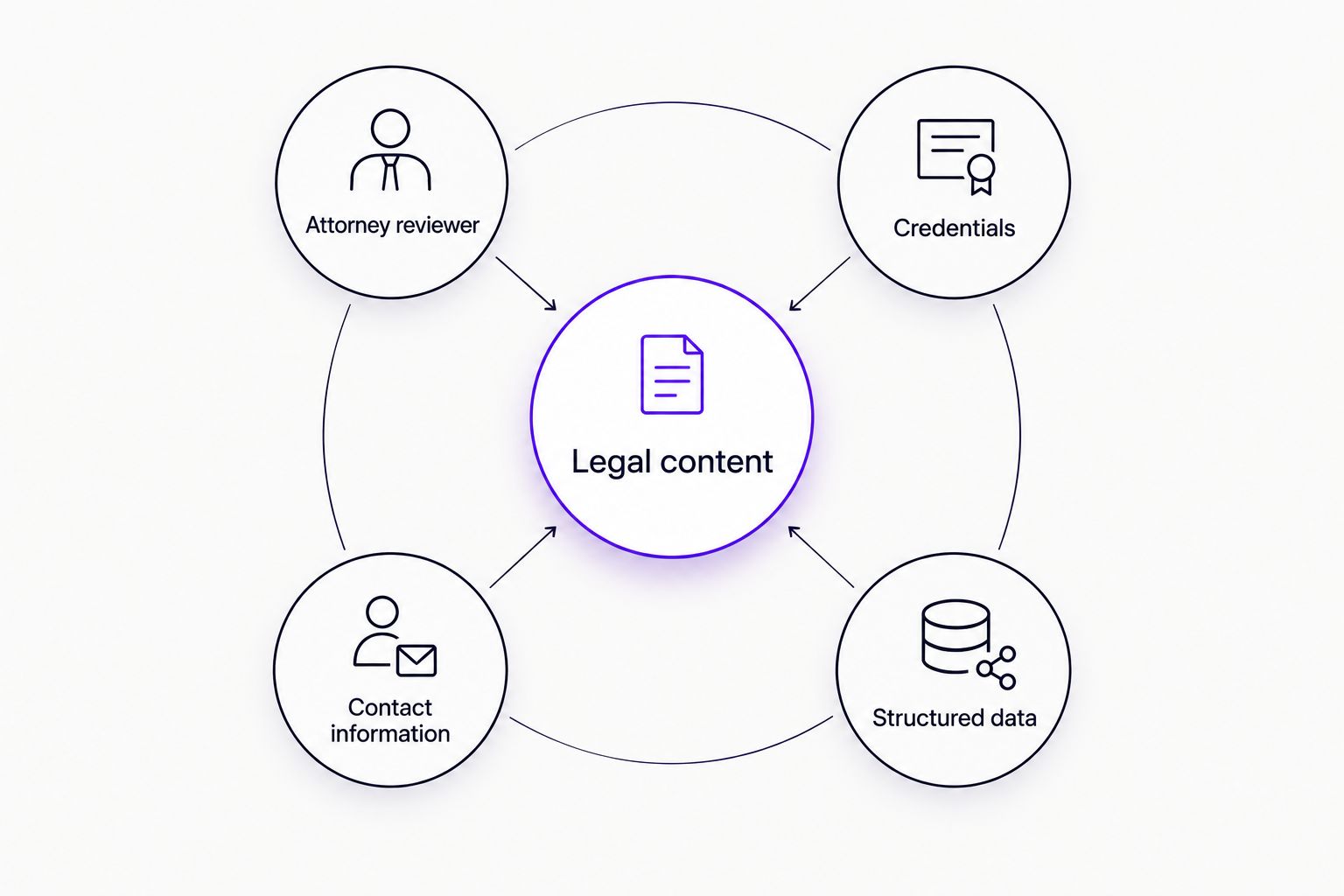
Visible legal expertise and consistent firm information belong together.
6. Publish supporting answers without duplicating location pages
Expand from the priority practice pages into questions that need their own explanation. Draft manually from approved source material and attorney guidance. A separate article earns its place when it answers a distinct issue, not when it swaps a city name into an existing paragraph.
Use internal links to connect the specific explanation with the relevant service. Readers should understand which attorney or practice handles the issue without encountering a sales pitch in every paragraph.
Off-page work should also use verifiable firm information. Relevant professional profiles and genuine editorial contributions can provide additional places to discover your expertise. Do not buy fabricated reviews or describe paid placements as independent endorsements.
Publish separate answers for materially different legal questions.
Explain jurisdictional differences rather than swapping place names.
Link educational content to the relevant practice page.
Maintain accurate professional and local business profiles.
Use client experiences only with appropriate permission and review.
Remove repetitive pages that offer no distinct information.
7. Measure citations alongside qualified inquiries
Use your original question set to create a repeatable observation process. Record the platform, exact prompt, date, cited URL, and whether the firm was named. Save the answer context so a citation is not confused with a recommendation.
Set a 30-day review interval for the initial program. This is a suggested reporting cadence, not a promised time to rank or receive citations. Keep query wording consistent and record changes in the platform or testing conditions.
Your 2026 report should separate observation from attribution. A manual answer check shows what appeared in that session; it does not establish visibility across all users. Analytics can identify some referral visits, but not every AI-influenced inquiry.
Track Google impressions, clicks, and landing pages separately.
Record AI citations and unlinked brand mentions as different events.
Review referral traffic without treating it as complete attribution.
Ask intake staff to record how prospects found the firm.
Track relevant inquiries and retained matters where records permit.
Prioritize changes tied to accuracy, accessibility, or inquiry quality.
Compare execution options for your firm
Choose an operating model based on what your team can approve and maintain. The best option is the one that closes your execution gap without weakening legal review.
Attorney-led manual program
Best for: Firms with internal editorial and website capacity
Main advantage: Direct control over legal explanations and approvals
Key limitation: Attorneys must coordinate technical work and measurement
In-house marketing team
Best for: Firms with recurring content and reporting needs
Main advantage: Close access to intake feedback and practice priorities
Key limitation: Specialist technical and GEO work still needs an owner
Visiblemonkey SEO and GEO services
Best for: Firms seeking coordinated agency execution
Main advantage: Service coverage across content, on-page, off-page, and technical search
Key limitation: The firm still needs attorney review and access approvals
Citation monitoring software
Best for: Teams that already have an execution process
Main advantage: Organizes observations across selected questions
Key limitation: Monitoring alone does not repair pages or verify legal accuracy
Choose services for implementation and monitoring tools for observation. Neither replaces qualified legal review. For a 2026 agency brief, specify the pages, jurisdictions, approval process, and business outcomes before discussing deliverables.
Plan your SEO and GEO work
Discuss content, on-page, off-page, and technical search services for your firm's priorities.
Common mistakes law firms make
Publishing legal rules without jurisdiction
An answer about deadlines, eligibility, or procedure loses essential meaning when the governing jurisdiction is missing. Put the jurisdiction beside the explanation and verify exceptions before publication.
Treating a citation as an endorsement
An assistant can cite a page to support a factual statement without recommending its firm. Report citations, mentions, recommendations, and inquiries separately; do not turn one into evidence of another.
Producing city pages without distinct service information
A replaced city name does not explain where an attorney is admitted, which office serves the reader, or whether the firm handles the issue. Publish location pages only when you can supply accurate, distinct information.
Publishing client stories without a review process
Case descriptions can expose confidential information or imply an outcome that another client should expect. Require permission and attorney review, and check applicable advertising rules before using testimonials or results.
Buying monitoring before fixing source pages
A dashboard records what it finds; it does not make inaccessible or inaccurate pages useful. Resolve crawlability, service clarity, and legal review before expanding the observation program.
FAQ
What is generative engine optimization for law firms?
Generative engine optimization for law firms is the practice of making legal expertise discoverable and citable in AI-generated answers. It combines accessible pages, accurate jurisdiction-specific content, clear attorney identity, and measurement of citations and inquiries.
Is GEO better than SEO for a law firm?
GEO is not a replacement for SEO. Law firms need accessible, useful source pages for search discovery while separately evaluating how AI assistants cite or mention their content.
Can a law firm guarantee placement in ChatGPT answers?
A law firm cannot guarantee placement in ChatGPT answers. An agency can control its content and technical work, but it does not control an assistant's response to every user.
Which pages should a law firm optimize first?
Optimize accurate practice-area pages and attorney information first. Then address supporting questions that match the firm's services and jurisdictions, rather than publishing unrelated legal topics.
Does legal content need attorney review?
Use attorney review for substantive legal explanations before publication. The reviewer should check jurisdiction, current authority, exceptions, and applicable advertising requirements.
Does schema markup guarantee AI citations?
Schema markup does not guarantee AI citations. Use it to describe visible firm, attorney, and service information accurately, alongside crawlable pages and useful explanations.
How should a law firm measure GEO results?
Measure recorded citations, brand mentions, referral visits, and qualified inquiries separately. Repeat a defined question set and retain the date, platform, prompt, and cited source so each observation has context.
One last thing
Make qualifications as easy to extract as the answer. If a legal explanation depends on a jurisdiction or an exception, include that condition in the same passage as the rule. A concise answer that loses its limits is the wrong answer to publish.
Choose one priority practice page and review its opening explanation, attorney responsibility, crawlability, and inquiry route. Fix that page before commissioning another batch of articles.